How to Knit in the Round
Knit seamless tubes for hats, socks, and sleeves: choose double-pointed needles, a circular needle, or magic loop, join without twisting, and avoid the ladder gap between needles.
Reviewed knitting references for working in the round on double-pointed needles, fixed circular needles, and magic loop, joining without twisting, and controlling laddering; needle length and method choice are project-specific and confirmed on your own work, and no pattern is prescribed.
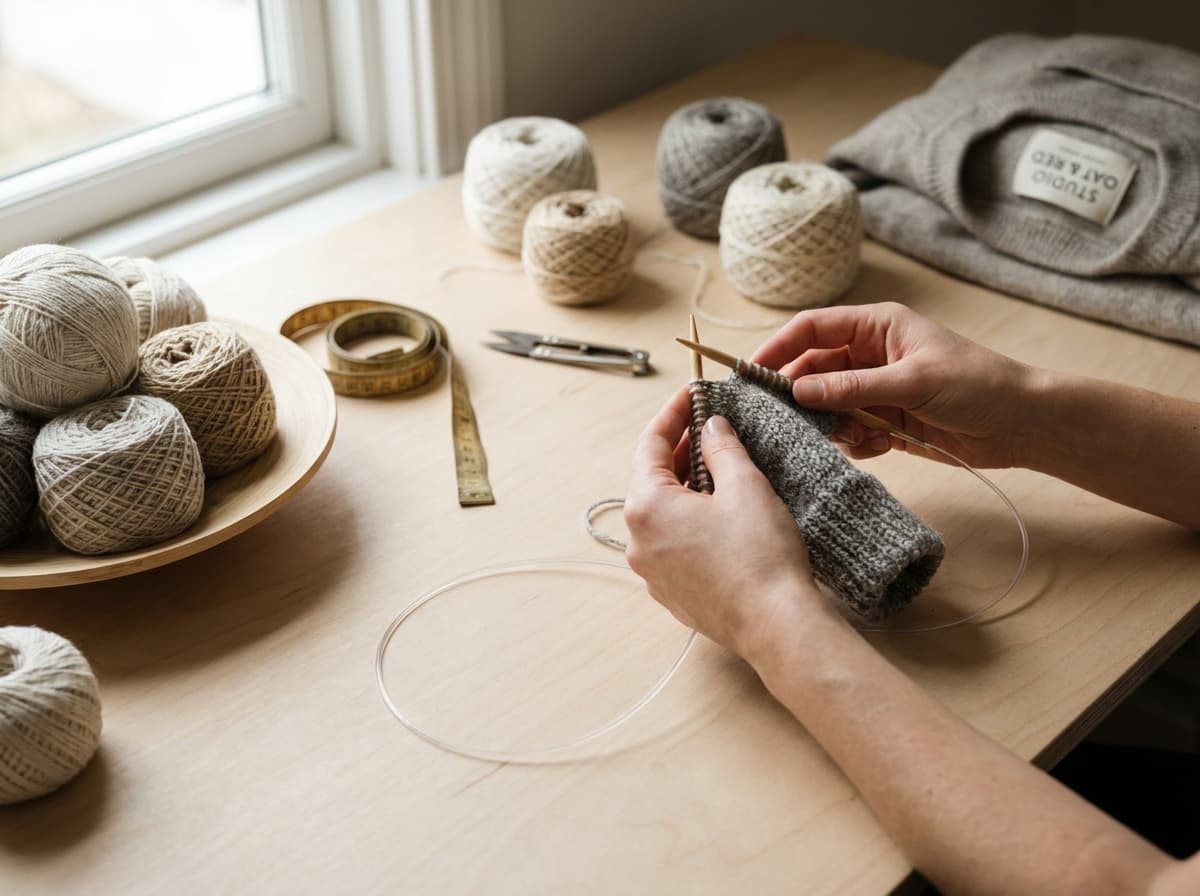
Knitting in the round makes a seamless tube — hats, socks, sleeves, cowls — by working continuously in a spiral instead of turning at the end of each row, which also means you knit every round to make stockinette (no purling back). There are three tools for it: double-pointed needles (DPNs) for small tubes, a fixed circular needle for tubes at least as big around as the cable is long (about 16 inches and up), and magic loop, which uses one long circular needle (32 inches or more) to work any diameter, even tiny ones. Whichever you use, the two things to get right are joining without twisting the cast-on (a twist becomes a permanent Möbius) and managing the ladder — the loose column that can appear where needles meet — by snugging the first stitch or two of each needle.
Working in the round is how most hats, socks, mittens, and sweater sleeves are made, because a seamless tube is stronger and neater than a seamed one. The choice between methods is mostly about the diameter of the tube.
Pick the method for the diameter
| Double-pointed needles (DPNs) | Stitches are divided over three or four short needles and knitted with another, forming a ring. The traditional choice for small tubes like socks and hat crowns; the main risks are dropping stitches off the ends and laddering at the needle joins. |
| Fixed circular needle | Two needle tips joined by a fixed cable. Works for tubes at least as big around as the cable length (commonly 16 inches and up), such as hats and sweater bodies. Simple and secure, but the cable must be shorter than the tube's circumference. |
| Magic loop | One long circular needle (32 inches / 80 cm cable or more), with the cable pulled out in a loop to split the stitches in two. Works any diameter, including very small tubes, so many knitters use it for everything and avoid DPNs entirely. |
Join without twisting
After casting on and before working the first round, lay all the stitches so the cast-on edge faces the same way, with none of it spiralling around the needle or cable. Then knit the first stitch to join the round. If the cast-on is twisted when you join, the tube becomes a permanent Möbius twist that cannot be corrected without ripping back to the join, so it is worth checking twice. Place a stitch marker at the join to mark the start of the round. Some knitters cast on one extra stitch and use it to close the join snugly, then decrease it away, which both tightens the join and helps confirm there is no twist.
Beat the ladder
The one flaw unique to knitting in the round with DPNs or magic loop is laddering: a loose vertical column where the work passes from one needle (or one half of the magic loop) to the next, because the yarn spans a small gap there. Control it by pulling the first stitch or two of each needle firmly, and by shifting where the needle changes fall every so often so any looseness does not stack in one line. It usually also evens out with blocking.
For the stitches themselves, remember that knitting every round in the round produces stockinette, so see knit stitch vs purl stitch; keep the tube the right size with knitting gauge and tension; and browse the knitting stitch library for round-worked patterns.
Sources and decision boundaries
The DPN, circular, and magic-loop methods, joining, and laddering guidance here follow knitting references including Tin Can Knits on the magic loop technique, Ysolda on knitting in the round with magic loop, and Nimble Needles on joining knitting in the round. Needle length and method choice depend on the project and your preference and are confirmed on your own work; this guide does not prescribe a pattern.
FAQ
What is the difference between DPNs, circulars, and magic loop?
Double-pointed needles divide the stitches over several short needles for small tubes like socks. A fixed circular needle works for tubes at least as big around as its cable (about 16 inches and up), like hats and sweater bodies. Magic loop uses one long circular needle (32 inches or more) to work any diameter, including tiny ones, so it can replace DPNs entirely.
How do I join in the round without twisting?
Before knitting the first stitch, make sure the whole cast-on edge faces the same way with no part spiralling around the needle or cable, then join. A twist at the join becomes a permanent Möbius that cannot be fixed without ripping back, so check twice. A stitch marker marks the start of the round.
Why is there a loose column of stitches in my tube?
That is laddering, and it happens where the work passes from one needle or one half of a magic loop to the next, because the yarn spans a small gap. Pull the first stitch or two of each needle firmly and shift where the needle changes fall so looseness does not stack in one line. Blocking usually evens out what remains.
Do I purl when knitting stockinette in the round?
No. Because you work continuously in a spiral without turning, knitting every round produces stockinette on the outside with no purling. This is one of the conveniences of working in the round; you only purl in the round when the stitch pattern (like ribbing or garter) calls for it.