How to Find a Clothing Manufacturer (US and Overseas)
The real channels founders use to find a factory, what US and overseas manufacturing cost in time and money, and how to vet a factory before you send a deposit.
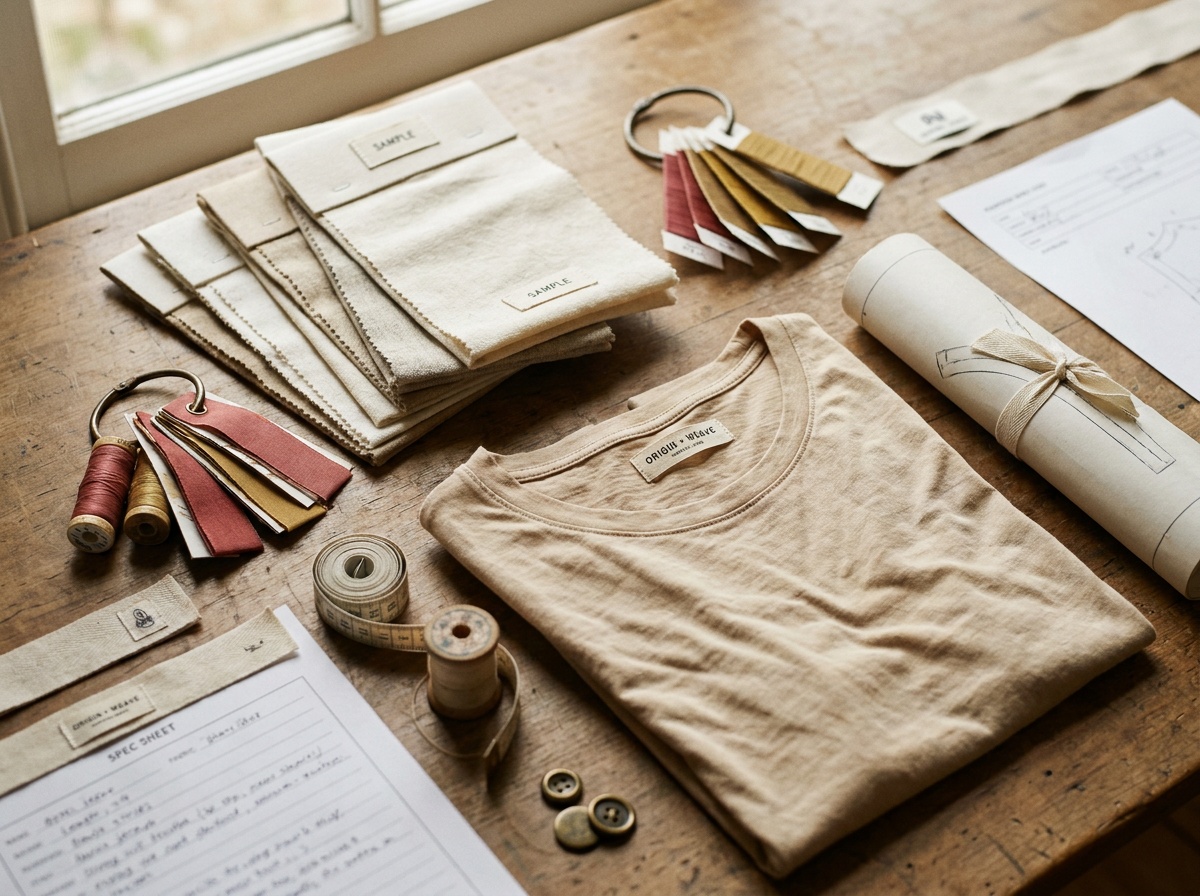
There is no single best place to find a clothing manufacturer. The right channel depends on your product, your budget, and how much hand-holding you need. Founders find factories through a handful of repeatable paths: directories and platforms (Alibaba, Sewport, Maker's Row), trade shows, sourcing agents, referrals through industry networks, and direct search. Finding a name is the easy part. Vetting the factory before you send money is where most first orders go wrong.
Most guides to "finding a manufacturer" stop at the directory list. The harder and more useful work is knowing what to expect once you find one: what a realistic MOQ looks like, what US versus overseas costs once shipping and duties are counted, and what questions separate a factory that will build your product from one that will waste three months of your runway.
Where founders find manufacturers
Five channels account for most of how brands find a factory. None of them is inherently better; they suit different stages and products.
Directories and platforms. Alibaba is the largest, mostly China and broader Asia. Its "Trade Assurance" and "Verified Supplier" badges are Alibaba-specific vetting filters, not industry-wide certifications, and they're the real signal to check before contacting a supplier there. Maker's Row lists US-only factories and is built around lower domestic MOQs, often in the 10 to 100 unit range per style. Sewport works as a global quote-request matching service, connecting brands directly with manufacturers without an agent in between. Europages lists EU cut-make-trim (CMT) manufacturers. IndiaMART and TradeIndia cover India.
Trade shows. SOURCING by Informa (the sourcing event formerly run under the MAGIC name, held in Las Vegas), Texworld, Première Vision, and the Canton Fair in China are the major global events. In the UK, Pure London, London Edge, Source Fashion, and the London Textile Fair serve the same function regionally. The tradeoff is consistent across sources: trade shows are the fastest way to touch fabric and get an answer in real time, but factories on the floor typically expect commitments of 300 to 500 units per style per color, which is a different (and higher) number than the MOQ you'd get contacting the same factory directly online. First-timers often find the floor overwhelming; go with a short list of questions ready.
Sourcing agents. An agent adds a per-unit markup and a layer of distance between you and the factory floor, but reduces the vetting burden and gives you one point of contact for the whole relationship. Vet an agent the same way you'd vet a factory: ask for a portfolio, ask for references, and expect a transparent, written process.
Referrals and industry network. Fashion-industry groups on LinkedIn and Facebook, other brand owners (some networks charge for access), and fashion incubators or trade schools are common paths to a factory that already has a working relationship with someone you trust.
Direct search. A specific Google query ("cut and sew hoodie manufacturer Portugal MOQ 150") outperforms a generic one ("clothing manufacturer"). Instagram is also a real channel, particularly for small manufacturers in the US and Pakistan who post their work and take direct messages.
US manufacturing vs overseas manufacturing: what changes
The question founders usually ask is "which is cheaper." The more useful question is total landed cost: unit price plus shipping, plus duties, plus insurance, plus the cost of your own time and cash tied up waiting. Overseas unit costs are usually lower, but overseas MOQs are usually much higher, so a small first order can cost less domestically even at a higher per-unit price. A 100-unit US order at $25 a unit can beat a 1,000-unit overseas order at $10 a unit on total cash outlay, before you've sold a single piece.
| Sampling lead time | US: 2 to 6 weeks. Overseas: 4 to 12 weeks, including return shipping. |
| Bulk production lead time | US: 2 to 8 weeks. Overseas: 6 to 16 weeks, commonly 60 to 90 days. |
| Shipping to your warehouse | US: 1 to 5 days by ground. Overseas: 20 to 45 days by sea, plus 1 to 2 weeks for customs. |
| Total concept to delivery | US: roughly 2 to 3 months. Overseas: roughly 4 to 6 months. |
| Duties on landed goods | US: none. Overseas: apparel carries some of the highest duty rates of any US import category. |
| Typical MOQ | US: 50 to 200 units per style. Overseas: 300 to 5,000+ units per style. |
| Quality control | US: in person, real time. Overseas: remote, often needs a third-party inspection. |
| Scalability | US: moderate, some factories cap out at volume. Overseas: high. |
Neither side is automatically the right answer. A simple product at real volume usually moves overseas once the math works. A first collection, a complex construction, or a brand that needs to see and touch samples in person often does better starting domestic, even at a higher unit cost, and moving overseas once volume justifies the higher MOQ.
What MOQ ranges to expect by region
MOQ (minimum order quantity) is the number a factory will not go below per style, usually per color, per order. Every sourcing guide gives a slightly different number for the same region, because it depends on the factory, the fabric, and the season. Treat the figures below as ranges, not fixed prices.
| US domestic | 50 to 200 units |
| China | 500 to 5,000+ units, though sub-500 runs exist in Yiwu for simple designs |
| Bangladesh | 500 to 5,000 units, best suited to high-volume basics |
| Vietnam | 500 to 1,500 units |
| Turkey | roughly 50 to 1,000 units, with fast 7 to 15 day delivery into Europe |
| India (Tirupur, Bangalore) | 50 to 1,000 units, generally the most flexible overseas hub for knits |
| Portugal and Italy | 30 to 500 units |
| Trade-show floor commitment | 300 to 500 units per style per color, different from a factory's direct-contact MOQ |
Two things change how you should read any stated MOQ. First, the trade-show number and the factory-direct number are not the same figure, and mixing them up is a common source of confusion for first-time founders: a factory that quotes 300 units on a show floor may accept a lower order contacted directly. Second, the factory's stated MOQ is often not the real floor. Fabric mills have their own minimums, typically 100 to 1,000 meters per color, and dye lots have minimums too. A factory willing to sew 150 units may still need you to buy fabric in a quantity that supports 400, because that's what the mill requires. Ask about fabric and dye-lot minimums separately from the factory's sewing MOQ.
Sampling and lead-time sequence
Production runs through the same sequence regardless of where the factory is located:
- Tech pack handed to the factory
- Fabric and trim sourcing
- Pattern making and grading
- First (fit) sample
- Revisions
- Pre-production sample (PPS), the benchmark bulk production is measured against
- Bulk production
- Quality control, at inline and final stages
- Shipping
Sample cost per unit runs noticeably higher than your bulk per-unit cost, since a sample carries the same setup and labor as a full run divided across one piece. Budget for it as a real line item rather than a rounding error.
How to vet a factory before you send money
Finding a factory that answers your email is not the same as finding a factory that will build your product correctly, on time, at the price it quoted. Vetting is the part of sourcing that determines whether the relationship works.
Ask for, at minimum:
- MOQ per style and per color, and whether it's negotiable
- A full cost breakdown: sample cost, unit cost, setup or development fees, shipping, and any volume discount tiers
- Sample lead time and bulk lead time, stated separately
- Whether they source fabric and trim themselves, and whether they'll ship physical swatches before you commit
- Their quality control process, including which AQL standard they use and whether inspection happens inline or only at the end
- References or past clients, ideally with factory-floor photos or video, not marketing photos from a brand's own site
- Who owns the pattern and tech pack if the relationship ends
- Payment terms and structure
On payment, a staged structure is common industry practice, though not universal: a deposit at order, a second payment when fabric arrives in-house, a progress payment at production complete, and a balance due at ship-ready. Treat this as typical, and confirm the specific structure in writing before you pay anything.
Work with a technical designer.
Got a quote back from a factory and not sure if the numbers or the terms are normal? A second opinion before you wire a deposit is cheaper than finding out after.
Questions to ask before you commit
The questions above cover cost and process. Before signing anything, also confirm capability and fit:
- Have they built this specific garment type before, with samples to show for it
- What's their current capacity, and where does your order sit in their queue
- Can you visit the factory floor, or get a live video walkthrough, before the first bulk order
- What happens if a shipment misses the agreed date
- What's their policy on defective units in a finished batch
Red flags that mean walk away
A few signals show up again and again across founders who've been burned:
Pressure to pay or place an order immediately, before you've seen samples or asked questions. Refusal to show factory floor photos or video, or to put terms in writing. Prices far below every other quote you've gotten for the same spec. Vague or evasive answers about production capability. Slow communication or a major language barrier before you've even placed an order. A factory that claims to "make anything." Specialization is normal in this industry: a denim factory does not also make lingerie, and one that says it does everything is often subcontracting work it can't do itself.
FAQ
Is Alibaba safe for a first-time brand?
It can work, but treat it as a directory to find candidates, not a guarantee of quality. Filter for suppliers with Trade Assurance and Verified Supplier status, ask for samples before any bulk order, and vet the factory the same way you would one found anywhere else.
Do I need a sourcing agent?
Not always. An agent adds a per-unit markup but reduces the vetting and communication burden, which can be worth it for a first overseas order or a founder without time to manage a factory relationship directly. For a domestic order or a straightforward product, many founders go direct.
What's a realistic MOQ for a brand starting out?
In the US, 50 to 200 units per style is a common starting range. Overseas, expect 300 units or more per style per color at most factories, though some hubs (Turkey, India, Portugal) go lower. MOQs vary by factory, fabric, and season, so confirm the number directly rather than assuming a regional average applies.
Can I visit an overseas factory before ordering?
Many brands do, especially before a first bulk order, and some sourcing agents build a factory visit into their service. If an in-person visit isn't practical, ask for a live video walkthrough of the floor instead of relying on photos alone.
How many manufacturers should I contact before choosing one?
Enough to compare on cost, lead time, and communication, typically a handful of serious candidates rather than one. Get a quote and a sample from more than one factory before committing to bulk production with any of them.
Reviewed by Karolyn, Technical Apparel Designer · kellyhouse.studio