Stitch and Seam Classes: The ISO and ASTM Reference
The full stitch-type and seam-type classification used across apparel production: the six stitch classes (100 to 600), the six ASTM seam classes (SS, LS, BS, FS, EF, OS), and how the two combine to specify a seam on a tech pack.
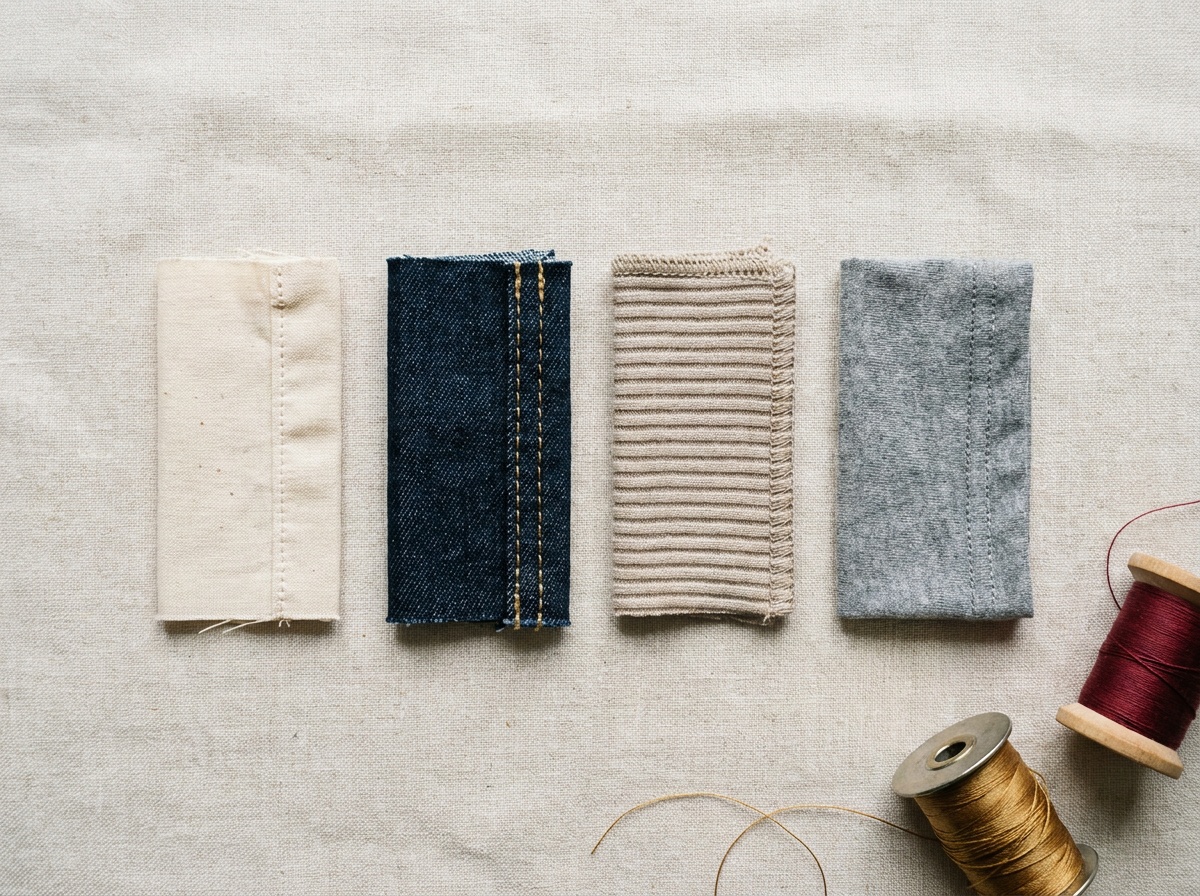
Apparel construction is described by two separate classification systems. Stitch types (ISO 4915) group every stitch by how its threads interlace, into six classes numbered 100 to 600. Seam types (ISO 4916, written with the ASTM letter codes SS, LS, BS, FS, EF, and OS) group every seam by how the plies of material are arranged. A finished seam on a garment is specified by naming one from each system, for example a plain superimposed seam sewn with a lockstitch is an "SSa seam, stitch type 301." Knowing both lets a designer, a technical designer, and a factory describe the same construction without ambiguity.
A "seam" and a "stitch" are not the same thing, and the industry keeps them in separate standards for a reason. The stitch is the thread structure that holds material together. The seam is the geometry of how the material is positioned before the stitch goes through it. A single stitch type can build many different seams, and a single seam type can be sewn with several different stitches. Specifying a garment means picking one of each.
Two international standards define these systems, and one North American practice restates them in the letter codes most tech packs use.
Two standards, one system
The classification traces back to the United States Federal Standard 751a, "Stitches, Seams, and Stitchings," which assigned the numeric stitch classes and the two-letter seam classes still in use. That standard was withdrawn, and its content now lives in two places a working designer will cite:
- ISO 4915 covers stitch types and gives each the three-digit number (301, 401, 504, and so on).
- ISO 4916 covers seam types and gives each a class plus a configuration.
- ASTM D6193, "Standard Practice for Stitches and Seams," is the North American document that carries the same definitions and uses the familiar two-letter seam codes (SS, LS, BS, FS, EF, OS).
The numbers and letters are stable across all three. A 301 lockstitch is a 301 everywhere, and an SSa seam means the same thing to a pattern maker in Los Angeles and a sewing line in Da Nang. That portability is the whole point of learning the codes.
The six stitch classes
Every machine stitch belongs to one of six classes, set by the first digit of its three-digit number. The class tells you the thread structure. The remaining digits identify the specific stitch within the class.
Class 100: Single-thread chainstitch
One needle thread loops through the material and interloops with itself on the underside. It uses no bobbin, so it never runs out of bottom thread, which is why bag-closing and long basting operations use it. Its weakness is the same as its structure: pull the tail and the whole line can unravel in one motion. Type 101 is the basic single-thread chainstitch. Type 103 is the blindstitch used for invisible hems.
Class 200: Originated as hand stitches
This class covers stitches formed by a single thread passed through the material as one line, the machine descendants of hand sewing. Saddle stitching and pick stitching sit here. On production garments it appears mostly as a decorative or tailoring detail rather than a structural seam.
Class 300: Lockstitch
Two threads, a needle thread from the top and a bobbin thread from below, interlace in the middle of the material. Type 301 is the single most common stitch in apparel and the default for wovens. It looks identical on both faces, holds tight, and resists unraveling because the two threads lock at every stitch. Its limitation is stretch: a straight 301 seam has little give and can pop on a knit or a close-fit woven under strain. The bobbin also runs out, which slows a production line. Type 304 is the zigzag lockstitch used for attaching elastic and for stretch on wovens.
Class 400: Multi-thread chainstitch
One or more needle threads interloop with one or more looper threads underneath. Type 401, the two-thread chainstitch, is the workhorse for long, strong, load-bearing straight seams: jeans side seams, inseams, and waistband joins. It carries more stretch than a lockstitch and builds a stronger seam, and it has no bobbin to replace. If it fails it can run back from the broken end, so it is backtacked or crossed by another seam at each terminal.
Class 500: Overedge chainstitch
One or more needle threads plus looper threads that wrap around the edge of the material, trimming and finishing in the same pass. This is overlocking, or serging. Type 503 is a two-thread edge finish. Type 504 is the three-thread overlock that finishes a raw edge and stretches with a knit. Types 512 and 514 are four-thread mock-safety stitches. Type 515 and 516 are five-thread safety stitches that combine an overedge with a chainstitch to seam and finish at once. The class stops fraying and gives stretch, which is why nearly every knit garment is assembled on it.
Class 600: Covering chainstitch
The most complex class, using up to nine threads: needle threads, looper threads, and a top-cover thread that lies across the top surface. It covers both faces of the seam flat, so it neither adds bulk nor irritates the skin. Type 602, 605, and 607 are the coverstitches and flatlocks that hem T-shirts and leggings, attach binding and elastic, and join the butted edges of activewear. It is the stretchiest, flattest seam available and the reason a good athletic hem lies smooth against the body.
| 100 Chainstitch | 1 needle thread · basting, bag closing · unravels easily |
| 200 Hand-origin | single line · saddle and pick stitch · decorative |
| 300 Lockstitch | needle + bobbin · wovens, topstitch · secure, low stretch |
| 400 Chainstitch | needle + looper · load-bearing seams · strong, some stretch |
| 500 Overedge | needle + looper wrap edge · knit seaming, finishing · stretch |
| 600 Covering | up to 9 threads · hems, binding, flatlock · flattest, stretchiest |
The six seam classes
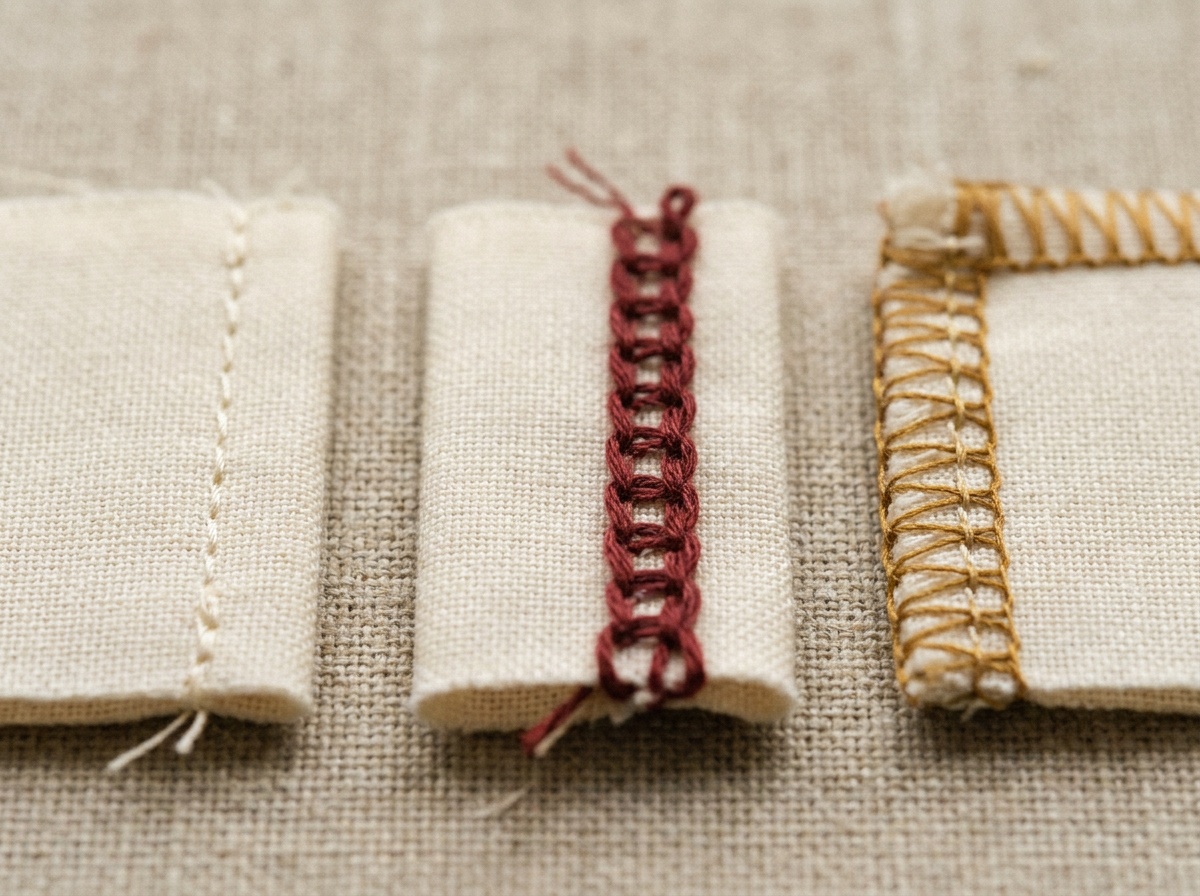
Where stitch classes describe thread, seam classes describe geometry: how many plies of material are involved and how they sit relative to each other and to their edges. ASTM D6193 uses six two-letter classes. A lowercase letter is added for the specific configuration, and a following number gives the rows of stitching, so a code reads like SSa-1 or LSc-2.
SS: Superimposed seam
Two or more plies stacked face to face and seamed a set distance in from the edge, then opened out. This is the plain seam, the most common construction in all of apparel. SSa is the basic version. Sewn with a 301 lockstitch on a woven or a 504 overlock on a knit, it joins almost everything: side seams, shoulder seams, center backs. ISO 4916 files this as its Class 1.
LS: Lapped seam
Plies overlapped rather than stacked, so each lies partly on top of the other. The lap lets both raw edges fold inside the join. LSc is the flat-felled seam of a jeans inseam and a work shirt, sewn with two rows so both edges are enclosed and the seam lies flat and strong. Lapped seams also attach patch pockets, plackets, and yokes. ISO Class 2.
BS: Bound seam
An edge, single or multiple ply, wrapped in a separate strip of binding and stitched through. The binding finishes and covers the raw edge in one component. BS seams bind necklines, armholes, and the inside seams of unlined jackets, and a contrast binding turns the finish into a visible detail. ISO Class 3.
FS: Flat seam
Two edges butted together, not overlapped, and joined by stitching that spans the gap so the seam lies completely flat with no ridge. Sewn with a class 600 coverstitch or flatlock, it is the low-bulk, non-chafing seam of performance base layers and seamless-feel activewear. ISO Class 4.
EF: Edge finishing
A single ply whose edge is finished or neatened, with no second ply joined. A serged raw edge, a turned-and-stitched hem, and a narrow rolled hem are all EF. EFb is the common folded hem. This class is about treating one edge, not joining two panels. ISO Class 6.
OS: Ornamental stitching
Stitching worked on a single ply for appearance rather than construction: topstitch detailing, pintucks, decorative rows. The stitch holds nothing together structurally, it is there to be seen. ISO Class 5.
| SS Superimposed | SSplies stacked, seamed from edge · plain seam · ISO class 1 |
| LS Lapped | LSplies overlapped · flat-felled, yokes · ISO class 2 |
| BS Bound | BSedge wrapped in binding · necklines, armholes · ISO class 3 |
| FS Flat | FSedges butted, joined flat · activewear · ISO class 4 |
| EF Edge finish | EFone edge neatened · hems, serged edge · ISO class 6 |
| OS Ornamental | OSstitching on one ply · topstitch, pintuck · ISO class 5 |
How a seam gets specified
A construction call-out names both systems at once. The seam class and configuration come first, the stitch type second:
SSa-1, stitch type 301 is a plain superimposed seam, one row, sewn as a lockstitch. That is a standard woven side seam.
LSc-2, stitch type 401 is a flat-felled lapped seam, two rows, sewn as a two-thread chainstitch. That is a jeans inseam.
EFb-1, stitch type 406 is a folded edge finish, one row of coverstitch. That is a knit T-shirt hem.
The letters and numbers each carry one piece of information. The two uppercase letters are the seam class (SS, LS, BS, FS, EF, OS). The lowercase letter is the specific configuration within that class (a, b, c, and so on, defined by the standard's diagrams). The trailing number is the count of stitching rows. The separate three-digit number is the stitch type from ISO 4915. Put together, a full call-out fixes the geometry and the thread structure with no room for interpretation.
This is why a tech pack construction page lists both. A line that reads "side seam: SSa-1, 301, 10 to 12 SPI" tells the factory the ply arrangement, the stitch, and the density, and a sample sewn anywhere in the world comes back the same. Leave the codes off and the factory chooses, which is how a stretch knit ends up with a popped lockstitch seam it should never have had.
Choosing the stitch and the seam
The seam class usually follows from the garment and the panel. Side seams are superimposed, jeans inseams are lapped, activewear joins are flat, hems are edge finishes. The stitch class follows from the fabric's behavior and the load on the seam:
- Stable woven, ordinary seam: superimposed seam, 301 lockstitch. Secure and clean, and the low stretch is not a problem on a woven.
- Woven under load, or a long structural seam: lapped or superimposed seam, 401 chainstitch. More strength and no bobbin changes on a long run.
- Any knit seam: superimposed or flat seam on a 504 overlock or a class 600 coverstitch, so the seam stretches with the fabric instead of restraining it.
- Raw edge that will show or fray: edge finish, 504 overlock, or a bound seam where the inside is visible.
- Hem on a knit: edge finish, 406 or 602 coverstitch, flat and stretchy so it lies against the body.
Thread choice, stitches per inch, and seam allowance sit on top of these decisions, and all of them belong on the tech pack next to the codes.
What is the difference between a stitch type and a seam type?
A stitch type describes how the threads interlace, classified by ISO 4915 into six classes numbered 100 to 600. A seam type describes how the plies of material are arranged, classified by ISO 4916 and written with the ASTM letter codes SS, LS, BS, FS, EF, and OS. A finished seam is specified by naming one of each, for example an SSa seam sewn with stitch type 301.
What are the six stitch classes?
Class 100 single-thread chainstitch, class 200 hand-origin stitches, class 300 lockstitch, class 400 multi-thread chainstitch, class 500 overedge (overlock), and class 600 covering (coverstitch and flatlock). The first digit of a stitch number gives its class, so 301 is a lockstitch and 504 is an overlock.
What do SS, LS, BS, FS, EF, and OS stand for?
They are the six ASTM D6193 seam classes: SS superimposed seam, LS lapped seam, BS bound seam, FS flat seam, EF edge finishing, and OS ornamental stitching. Each maps to a numbered ISO 4916 class, and each takes a lowercase configuration letter and a row count, such as SSa-1 or LSc-2.
Why is a 301 lockstitch not used on knits?
A straight 301 lockstitch has little stretch, so on a knit it can pop when the fabric extends. Knits are seamed on class 500 overlock or class 600 coverstitch machines, which stretch with the fabric. A lockstitch is still used on knits where the seam does not need to stretch, such as attaching a stable neckband tape.
Where does ASTM D6193 come from?
It restates the stitch and seam definitions of the withdrawn US Federal Standard 751a, which set the numeric stitch classes and two-letter seam classes. The same definitions are carried internationally by ISO 4915 for stitches and ISO 4916 for seams, so the codes are stable across standards.
Putting it on the tech pack
The value of the system is that it removes interpretation from the sewing line. A construction page that lists the seam code, the stitch type, and the stitch density for every operation gives a factory an unambiguous target, and a sample sewn to those codes is repeatable across suppliers and across production runs. If a garment relies on a specific construction to fit, wash, or wear correctly, that construction belongs in the standard's codes, not in a photograph the factory has to guess from.
Work with a technical designer.
Construction call-outs, stitch and seam specification, and tech-pack pages built to production standard for brands taking a garment to a factory.
Reviewed by Karolyn, Technical Apparel Designer · kellyhouse.studio