Knitting Gauge and Tension, Explained
What gauge is, how to knit and measure a swatch, and how to adjust needle size when your gauge is off.
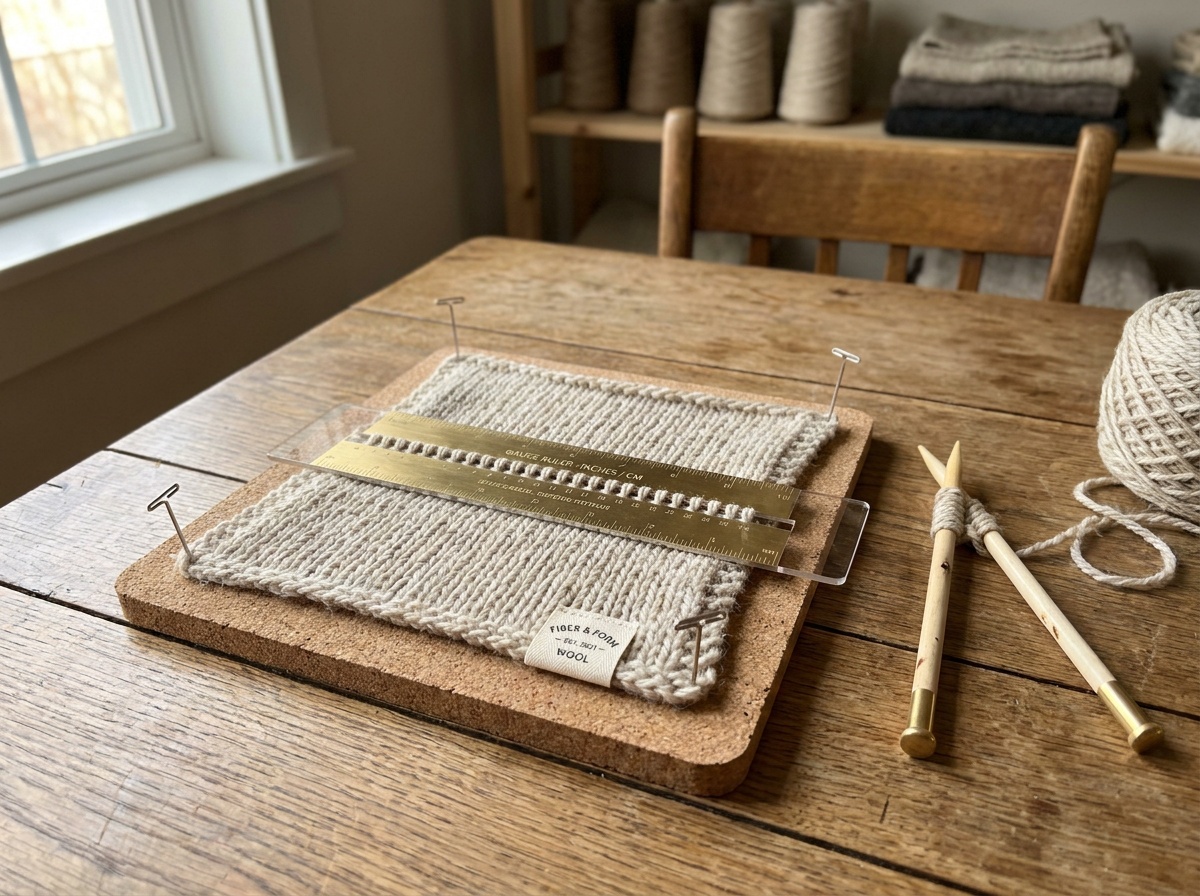
Gauge is the number of stitches and rows a knitted fabric measures over 4 inches (10 cm), always stated per 4 inches and never per inch. It decides your finished size: a pattern's dimensions are built on its stated gauge, so if your stitches come out a different size, the piece comes out a different size. You match gauge by knitting a swatch in the pattern stitch, washing and blocking it the way you will treat the garment, then measuring a clean span in the middle. More stitches per 4 inches than the pattern means your knitting is too tight, so go up a needle size; fewer means it is too loose, so go down. US patterns call this gauge; UK patterns call the same thing tension.
Gauge is the one measurement that connects your hands, your yarn, and the pattern's math. Every stitch count in a sweater pattern, the number cast on, the number decreased at each armhole, was calculated from a single gauge figure. Hit that figure and the numbers produce the size on the label. Miss it, even by half a stitch per inch, and the error multiplies across hundreds of stitches into a garment that is a size too big or too small.
What gauge and tension mean
Gauge is written as two numbers over a 4-inch (10 cm) square: stitches across, and rows down. A worsted-weight pattern might read "18 sts and 24 rows = 4 inches in stockinette." That is the fabric the designer knit, at the density the whole pattern depends on.
| 18 sts = 4 in | Stitch gauge: 18 stitches span 4 inches across the fabric |
| 24 rows = 4 in | Row gauge: 24 rows span 4 inches down the fabric |
| in stockinette | The stitch pattern the gauge was measured in; measure yours the same way |
| on US 8 (5 mm) | The needle the designer used, a starting point, not a rule |
| after blocking | The fabric state the gauge refers to; block your swatch before measuring |
Gauge is always quoted per 4 inches, not per inch, and there is a practical reason: measuring across four inches averages out the small irregularities in individual stitches. One inch of knitting can read half a stitch off from natural unevenness. Four inches gives you a stable number you can trust. US patterns use the word gauge; UK patterns use tension for the identical concept, so treat the two words as interchangeable when reading a pattern.
Why gauge decides finished size
A pattern does not tell you to knit a 20-inch-wide sweater front. It tells you to cast on a stitch count, and that count only produces 20 inches if your stitches are the size the pattern assumes. Work the math backward and the stakes are clear.
Say a pattern's gauge is 18 stitches over 4 inches, which is 4.5 stitches per inch, and the front is 90 stitches wide. At the correct gauge that front is 20 inches. Knit at 5 stitches per inch instead, only half a stitch tighter, and those same 90 stitches measure 18 inches. Two inches vanish from a single panel. Double it for front and back and the sweater is four inches smaller around, a full size or more. This is why a swatch that feels like a delay is the fastest way to avoid reknitting a whole garment.
How to knit a proper swatch
A swatch has to imitate the real fabric, so it has to be knit the way the real fabric will be knit and treated.
- Cast on more stitches than 4 inches' worth. The pattern's gauge tells you roughly how many stitches make 4 inches; add several inches on top so you have a measurable area away from the edges. A swatch around 6 inches wide is a safe target.
- Work in the pattern stitch the gauge was measured in. If the gauge says stockinette, knit stockinette. If it specifies a cable or lace repeat, work that repeat, because different stitch patterns pull in or spread out to different widths.
- Knit enough rows to make the swatch as tall as it is wide. Edge rows distort the same way edge stitches do.
- Wash and block the swatch exactly as you will treat the finished garment: same water temperature, same soak or steam, same drying method. Then let it dry fully before measuring.
Do not bind off tightly and measure a swatch still curling at the edges. Stockinette curls until it is blocked. Pin the damp swatch flat, let it dry, and measure it relaxed. A swatch measured under tension lies to you.
Measuring the swatch and reading the result
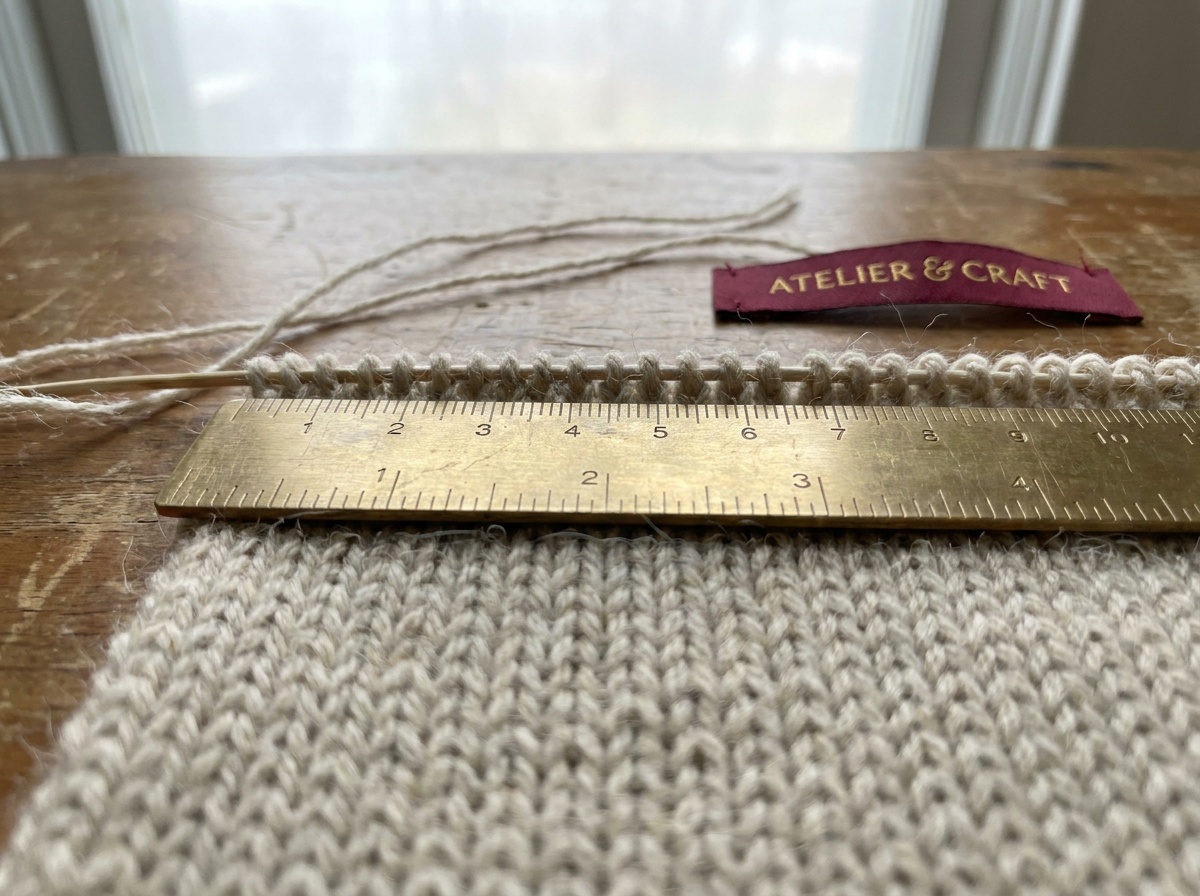
Lay the dry, blocked swatch flat with no stretching. Place a ruler or gauge tool in the middle of the fabric, away from the cast-on edge, the bind-off edge, and both side edges, where the stitches are even. Count the stitches across a 4-inch span, including partial stitches, then count the rows down a 4-inch span the same way.
Compare your count to the pattern's, and adjust needle size by this rule:
| More sts per 4 in than the pattern | Your stitches are smaller, so your knitting is too tight. Go up a needle size. |
| Fewer sts per 4 in than the pattern | Your stitches are larger, so your knitting is too loose. Go down a needle size. |
| Exactly the pattern's count | Gauge matches. Cast on with this needle. |
The direction trips people up because it feels backward. A larger needle makes larger stitches, so fewer of them fit in 4 inches. If you have too many stitches packed into your span, you need bigger stitches, which means a bigger needle. Change one needle size at a time, reknit the swatch, and remeasure. Half a stitch of difference is worth chasing on a fitted garment.
Stitch gauge matters more than row gauge
For most garments, hitting stitch gauge is the priority and row gauge is secondary. Width is fixed at cast-on: once you commit a stitch count, the piece is as wide as your stitch gauge makes it, with no way to adjust as you go. Length is different. Most patterns tell you to knit to a measurement, "work until the piece measures 15 inches," rather than to an exact row count, so if your row gauge runs a little off you knit a few more or fewer rows and the length still lands.
Row gauge starts to matter when a pattern ties shaping to row counts rather than measurements: a sleeve that increases every 6th row a set number of times, a yoke worked over an exact number of rounds, or a piece knit sideways where rows become width. When you see shaping locked to row counts, match row gauge as carefully as stitch gauge, or recalculate the shaping to your own row gauge.
When gauge matters most, and when it matters least
Gauge is not equally critical on every project. Match its importance to how much the finished size has to be exact.
| Fitted sweaters, hats, gloves | Critical. These are worn close to the body and a size off is a size off. Always swatch. |
| Socks | High. Fit is tight and small errors compound around the foot. |
| Loose or oversized garments | Moderate. Some ease absorbs small gauge differences, but large errors still show. |
| Blankets, scarves, wraps | Low. An inch either way rarely matters; gauge mostly affects yarn used and drape. |
On a blanket, being off gauge means it comes out a little larger or smaller and you use a little more or less yarn. On a sweater, being off gauge means it does not fit. Swatch seriously for anything shaped to the body, and relax about it on flat, unfitted pieces where the exact dimensions are forgiving.
Blocking changes gauge, so block the swatch
Washing and blocking rearrange the fabric. Stitches relax, even out, and settle into their final size, and many fibers change measurably in the process. Superwash wool and some plant fibers can grow when wet. Untreated wool evens out and can bloom to fill gaps. A swatch measured straight off the needles, before blocking, reports a gauge the finished garment will not keep, because you are going to wash that garment.
Block every swatch you plan to trust, and block it the way you will block the real piece. If you skip blocking on the swatch but block the sweater, you measured one fabric and knit another. The swatch is only a fair prediction of the garment when it goes through the same treatment.
Why is gauge measured over 4 inches instead of per inch?
Measuring across 4 inches averages out the small irregularities in individual stitches, giving a stable, reliable number. A single inch can read half a stitch off from natural unevenness in hand knitting, which would throw off the whole calculation.
My swatch has too many stitches per 4 inches. Do I go up or down a needle size?
Go up a needle size. Too many stitches in the span means your stitches are too small and your knitting is too tight. A larger needle makes larger stitches, so fewer of them fit in 4 inches, bringing your count down to match the pattern.
Do I need to block a swatch before measuring it?
Yes, if you plan to wash or block the finished garment. Blocking relaxes and resizes stitches, and some fibers grow or bloom when wet. A swatch measured before blocking predicts a fabric your washed garment will not match.
Does gauge matter for a blanket the way it does for a sweater?
No. A blanket a little larger or smaller than planned still works; the main effect is how much yarn you use and how the fabric drapes. Gauge is critical for fitted garments like sweaters, hats, and socks, where an inch off changes whether the piece fits.