How to Sew with Knit Fabric Without a Serger
Sew stretchy knit fabric on an ordinary machine: the right needle, a stitch that stretches, how to stop wavy seams, and a clean twin-needle hem, no serger required.
Established sewing references reviewed for needle choice, stretch stitches, feeding and presser-foot pressure, and hemming methods for knit fabric on a standard machine; no universal stitch settings are prescribed, since knit stretch, recovery, and weight vary and are confirmed on a test scrap.
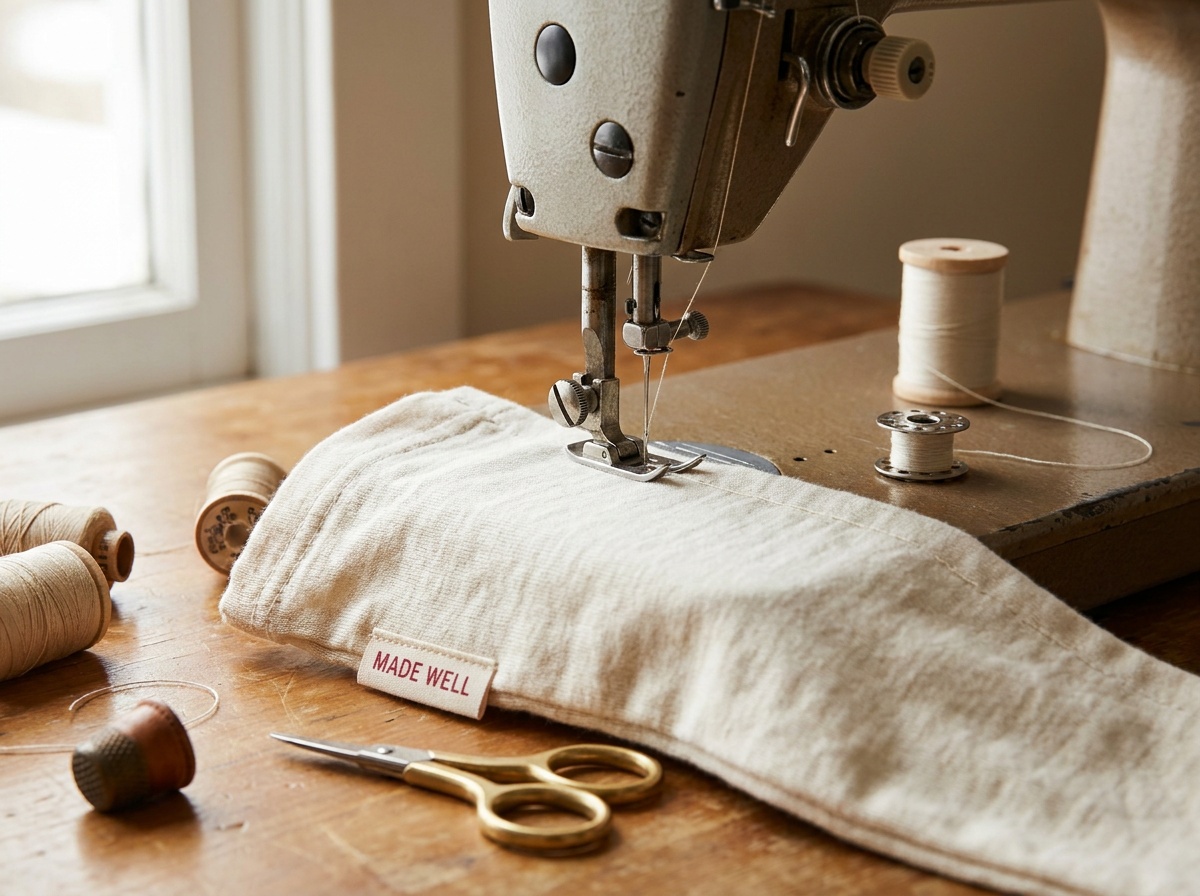
You do not need a serger to sew knits. Fit a ballpoint needle, or a stretch needle for fabric with a lot of spandex, and seam with a stitch that stretches, either a narrow zigzag or your machine's lightning-bolt stretch stitch, never a plain straight stitch, which pops when the seam is stretched. To stop the fabric waving out, lower the presser-foot pressure, fit a walking foot if you have one, and let the fabric feed itself rather than pulling it. Hem with a twin needle for a clean, stretchy finish. Knits vary, so test your needle, stitch, and settings on a scrap first.
Knit fabric intimidates people because it moves, and a machine set up for stable wovens fights it. The fix is a handful of setup changes, all available on an ordinary sewing machine. A serger makes a professional inside finish and is faster, but it is not required to make a knit garment that fits and holds together.
Use a ballpoint or stretch needle
A knit is looped rather than woven, so a sharp needle can pierce a loop and leave a run or a hole. Match the needle to that.
| Ballpoint (jersey) | A rounded tip that slips between the loops and pushes them aside instead of splitting them. The default for most cotton, wool, and viscose jersey and interlock. |
| Stretch | Also rounded, but with a deeper scarf shaped to prevent skipped stitches on fabrics with a lot of spandex or Lycra, such as activewear and swimwear. Reach for it when a ballpoint skips stitches. |
| Not a universal (sharp) | A standard sharp needle is for wovens and can cut a knit loop. If your only problem is skipped stitches on a stretchy fabric, the needle, not the machine, is usually the cause. |
For more on matching needle type and size to fabric, see the sewing machine needle guide.
Seam with a stitch that stretches
A plain straight stitch has no give, so when a knit seam is stretched the thread has nowhere to go and it snaps. Use a stitch that can stretch with the fabric.
| Narrow zigzag | A zigzag of roughly 0.5 to 1 width and around 3 length. The zigzag lets the seam extend without popping. The simplest option, available on any machine. |
| Lightning-bolt stretch stitch | A built-in stitch on many machines that looks like a slight zigzag straight line and is purpose-made for stretch seams. Slower to sew but strong and low-profile. |
| Straight stitch, only where it will not stretch | Acceptable on stable, low-stretch areas that stay put, such as a shoulder seam that has been stabilised, but not on anything that must extend to go on the body. |
Stop the seams waving out
Wavy, rippled seams are a feeding problem, not a stitch problem. The machine stretches the fabric as it feeds and it never fully recovers.
- Lower the presser-foot pressure. Too much pressure stretches the fabric under the foot. A low setting, often around one, lets it pass without being pulled long.
- Fit a walking foot. It has its own feed dogs on top, so the top and bottom layers move together instead of the bottom being dragged ahead.
- Do not pull the fabric. Guide it, but let the feed dogs do the moving. Pulling stretches the seam permanently.
- Stabilise the stretch you do not want. Shoulder seams and necklines should not grow, so sew clear elastic or a strip of fusible stay tape into those seams to hold them to length.
Hem with a twin needle
A twin needle is the clean way to hem a knit on a regular machine. Two needles share one bobbin, so the top shows two parallel rows of straight topstitching while the bobbin thread zigzags between them underneath, and that underside zigzag is what lets the hem stretch. Fold the hem up once, sew from the right side with the twin needle, and trim the excess underneath. If you do not have a twin needle, a single narrow zigzag hems a knit well enough, just with one visible line instead of two.
Finishing the seam allowances is optional
Knits do not fray, so an unfinished seam allowance will not unravel the way a woven one does. You can leave the allowances raw, or zigzag or trim them close if you prefer a tidier inside. This is the one place a serger clearly wins on speed and neatness, but the seam itself is already secure without it.
Knit fabrics differ enormously in stretch, recovery, and weight, so there is no single correct needle, stitch, and pressure for all of them. Before the real seam, sew a test on a doubled scrap of the exact fabric, stretch it to check the stitch holds, and adjust the needle, stitch, tension, and pressure until it feeds flat and stretches without popping.
Sources and decision boundaries
The needle, stitch, feeding, and hemming methods here follow established sewing references such as the Seamwork tutorials on sewing knits without a serger and the WeAllSew guide, and Sew DIY. Exact settings depend on the fabric and machine and are not prescribed here; a test scrap of the specific knit is the final check. For choosing an interfacing that keeps a knit's stretch, see how to choose interfacing.
Can you sew knit fabric on a regular sewing machine?
Yes. A serger is faster and gives a professional inside finish, but a standard machine sews knits well with a ballpoint or stretch needle and a stitch that stretches, such as a narrow zigzag or a built-in stretch stitch. Knits do not fray, so the seam allowances do not even need finishing.
What needle should I use for knit fabric?
A ballpoint or jersey needle for most knits, because its rounded tip slips between the loops instead of piercing them. For fabric with a lot of spandex, such as activewear or swimwear, use a stretch needle, which is shaped to prevent skipped stitches. A sharp woven needle can cut a knit loop and cause runs.
What stitch is best for sewing knits?
A stitch that can stretch with the fabric. A narrow zigzag, roughly 0.5 to 1 wide and about 3 long, or your machine's lightning-bolt stretch stitch, both let the seam extend without the thread snapping. A plain straight stitch has no give and pops when a knit seam is stretched.
Why does my knit seam come out wavy?
The machine is stretching the fabric as it feeds it. Lower the presser-foot pressure, fit a walking foot so both layers move together, and stop pulling the fabric through; guide it and let the feed dogs move it. For seams that should not stretch at all, such as shoulders, sew in clear elastic or stay tape.
How do I hem knit fabric?
A twin needle gives the cleanest stretchy hem on a regular machine: two rows of topstitching on the front with a zigzag of bobbin thread underneath that lets the hem stretch. A single narrow zigzag also works. Avoid a plain straight-stitch hem, which will pop the first time the hem is stretched over a hip or hand.