Understanding Crochet Gauge
Match a crochet pattern's size by making and measuring a proper gauge swatch, and changing hook size — not tension — until your stitch and row counts match.
Reviewed crochet gauge references for making and measuring a swatch, counting stitches and rows over a defined length, and adjusting hook size to match pattern gauge; exact hook, yarn, and stitch counts are pattern-specific and confirmed on your own swatch, and no gauge is prescribed.
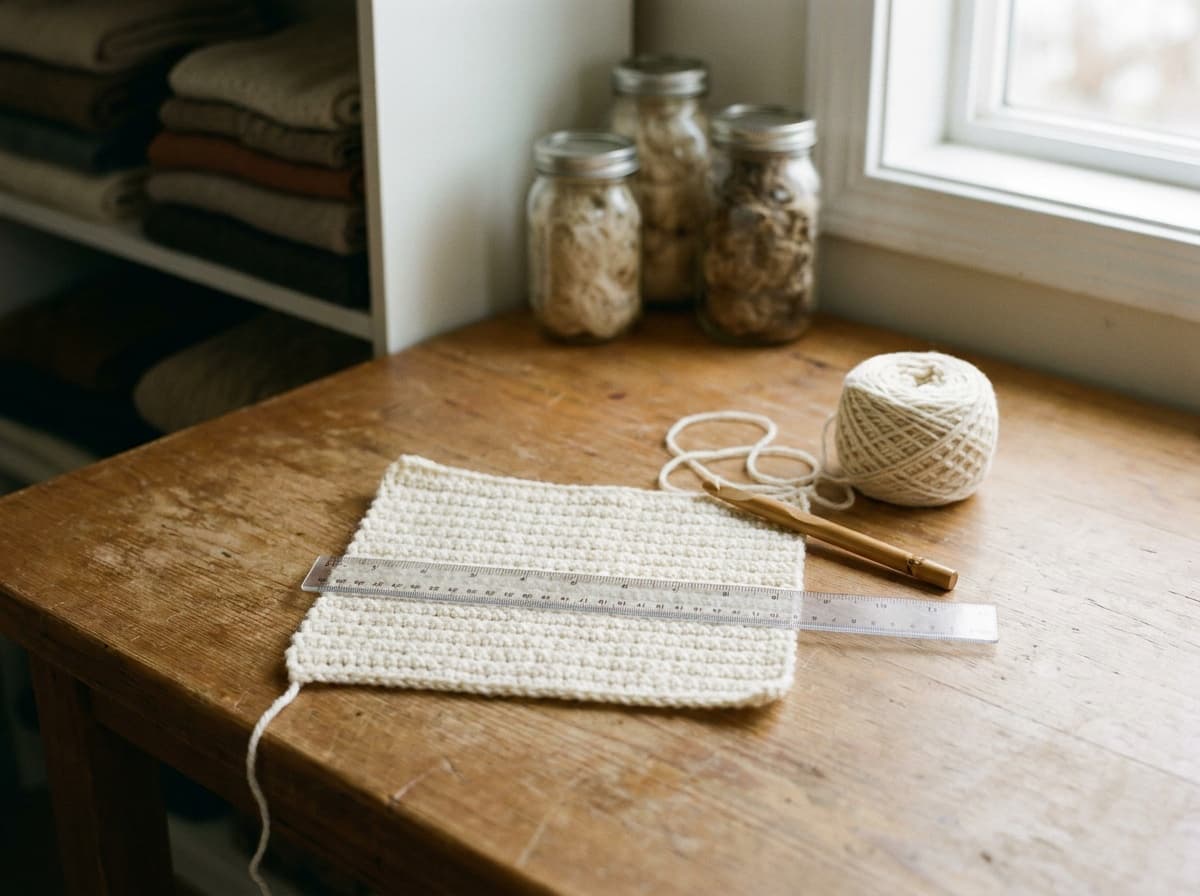
Gauge is how many stitches and rows fall in a set distance (usually 4 inches / 10 cm) in a given yarn, hook, and stitch pattern, and it is what makes your finished piece the size the pattern intends. To check it, crochet a swatch in the pattern's stated stitch, at least 6 inches square so you can measure away from the tighter edges, then lay a ruler across the middle and count the stitches and rows in 4 inches. If you have more stitches than the pattern, your work is too tight, so go up a hook size; if you have fewer, it is too loose, so go down a hook size. Change the hook, not your natural tension, and re-swatch until both the stitch and the row counts match. Skipping gauge is the single most common reason a garment comes out the wrong size.
Gauge feels like a step worth skipping because it is not the "real" project, but it is the whole reason a pattern's measurements translate to your hands. Two crocheters with the same yarn and hook can produce fabric at different sizes, and gauge is how you close that gap before you have made a whole garment at the wrong size.
Make the swatch properly
| Use the pattern's stitch | Work the swatch in the exact stitch pattern the gauge is quoted in (for example single crochet, or a shell repeat), because different stitches give completely different gauges in the same yarn. |
| Make it big enough | Aim for at least a 6-inch square. Edge stitches pull tighter or looser, so a swatch needs margin around a clean 4-inch measuring area in the centre. |
| Use the real yarn and hook | Swatch in the actual yarn you will use and the hook you plan to start with. A substitute yarn or a different hook changes the result. |
| Treat it like the finished piece | If you will wash and block the finished item, wash and block the swatch the same way before measuring, because many yarns relax or grow with blocking. |
Measure the centre, count carefully
Lay a ruler flat across the middle of the swatch and count how many stitches fall in 4 inches (10 cm), then count the rows in 4 inches the same way. Count in the centre, never across the edges, and include partial stitches, because a half-stitch difference over 4 inches becomes inches over a garment. Most patterns quote gauge over 4 inches, but very fine yarns sometimes quote over 2 inches or 1 inch, so match whatever span the pattern uses.
Adjust with hook size, not tension
If your stitch count is higher than the pattern's, your stitches are too small, so switch to a larger hook; if it is lower, switch to a smaller hook. Do not try to consciously crochet looser or tighter, because you cannot hold an altered tension consistently over a whole project and it will drift back. Re-swatch after every hook change and keep going until the counts match. Stitch gauge (width) usually matters most for fit, but check row gauge too, since some patterns depend on it; if you can only match one, matching stitch gauge and adjusting row count by instruction is common. Getting gauge is worth the time it costs.
Use the hook and needle reference to move between hook sizing systems as you change hooks, and see yarn weights explained for why the pattern's yarn weight is part of the gauge. The crochet stitch library shows the stitch patterns a gauge might be quoted in.
Gauge-swatch record
Crochet gauge-swatch record
Log each swatch so you know which hook matched the pattern, and can reproduce it later.
Saved in this browser only, never sent to a server.
Pattern target
Swatch attempts (repeat)
Result
Sources and decision boundaries
The swatch, measuring, and hook-adjustment method here follows crochet gauge references including the Craft Yarn Council on gauge and why it matters, Yarnspirations on how to measure crochet gauge, and Dora Does on making and measuring a crochet gauge swatch. Your matching hook, yarn, and stitch counts are specific to your hands and materials and are confirmed on your own swatch; this guide does not prescribe a gauge for any pattern.
FAQ
Do I really need to make a gauge swatch?
For anything that must fit or finish to a size — garments, hats, bags — yes. Gauge is what makes the pattern's measurements match your hands, and two crocheters with the same yarn and hook can crochet at different sizes. For a scarf or blanket where exact size does not matter, you can skip it, but you may use more or less yarn than the pattern states.
My gauge is off — should I crochet tighter or looser?
Neither. Change your hook size instead: go up a hook if you have too many stitches (too tight) and down a hook if you have too few (too loose). You cannot hold a deliberately altered tension consistently over a whole project, so it will drift, whereas a different hook changes the gauge reliably.
What if I can match stitch gauge but not row gauge?
Match stitch gauge first, since width usually drives fit. Many patterns let you work to a length or a number of rows by measurement, so a small row-gauge difference can be handled by instruction. Some textured or row-dependent patterns need both, so check what the pattern relies on before committing.
Should I block my gauge swatch before measuring?
If you will block the finished piece, yes — wash and block the swatch the same way and measure it after, because many yarns relax, grow, or even out with blocking. Measuring an unblocked swatch for a piece you intend to block can give a gauge that changes once the real item is finished.