Stitch Types and Seam Types: The Classes Explained
The six stitch classes and eight seam classes used in apparel, in plain language with common examples, sourced from the public-domain federal standard and the current ISO and ASTM references.
Public-domain US Federal Standard 751a and the published scopes of ISO 4915, ISO 4916, and ASTM D6193 reviewed for the class-level structure, names, and common examples of stitch and seam types. Class names and numbering are described in words from public-domain and general references; no licensed ISO or ASTM technical diagram or full subtype code table is reproduced.
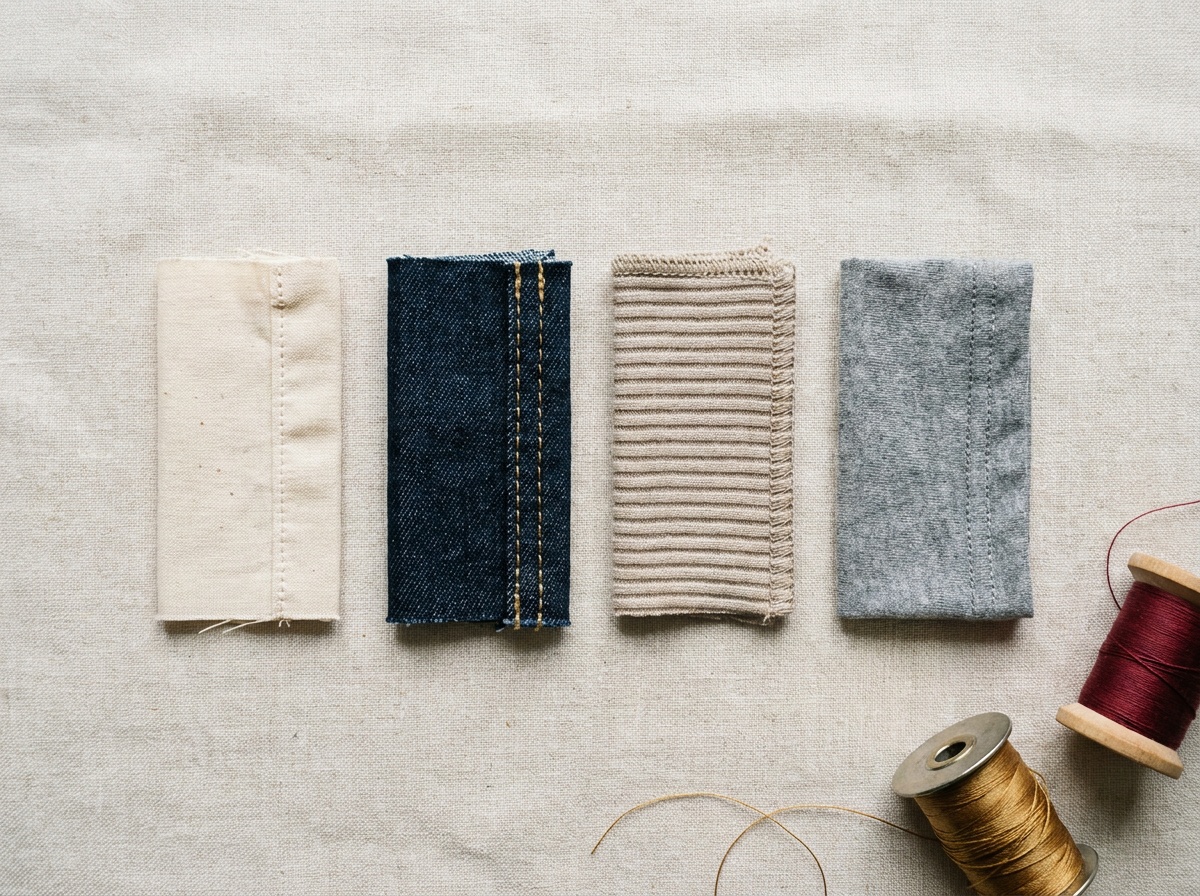
Apparel stitches fall into six classes by how the threads form: 100 single-thread chainstitch, 200 stitches originating as hand stitches, 300 lockstitch, 400 multi-thread chainstitch, 500 overedge chainstitch (overlock), and 600 covering chainstitch (coverstitch). Seams fall into eight classes by how the plies are arranged: 1 superimposed, 2 lapped, 3 bound, 4 flat, 5 decorative, 6 edge finishing, 7 attaching a separate item, and 8 single-ply. Stitch class and seam class are two separate systems: a seam of any class is sewn with a stitch of some class. The class is an orientation, not a full specification.
The numbering everyone uses comes from a public document. US Federal Standard 751a, "Stitches, Seams, and Stitchings," is a government work in the public domain, and it is the origin of the numeric stitch and seam classification. The current standards carried it forward: ISO 4915 classifies stitch types, ISO 4916 classifies seam types, and ASTM D6193 is the current US practice that superseded the federal standard. The ISO and ASTM documents are licensed, so this page describes the classes in words with common examples rather than reproducing their diagrams or full code tables.
The six stitch classes
A stitch type describes how the threads interlace. The first digit of a stitch number is its class, so a 301 is a class 300 stitch and a 504 is a class 500 stitch.
| 100 · Single-thread chainstitch | One needle thread loops through itself on the underside. Quick to run and easy to pull out on purpose, so it suits basting and some blindhems. Example: 101 single-needle chainstitch, 103 blindstitch. |
| 200 · Originating as hand stitches | Types that reproduce or descend from hand sewing, used in tailoring, padding, and fine finishing. Example: a hand pick stitch or saddle stitch on a tailored lapel. |
| 300 · Lockstitch | A needle thread and a bobbin thread lock in the middle of the plies. It looks the same on both faces, has little stretch, and is secure. The default on woven seams and topstitching. Example: 301 single-needle lockstitch, 304 zigzag. |
| 400 · Multi-thread chainstitch | Needle threads loop with looper threads for a strong, slightly stretchy seam. Common on jeans and knit seams. Example: 401 two-thread chainstitch, 406 bottom-cover hem. |
| 500 · Overedge chainstitch (overlock) | Looper threads wrap the raw edge as it is sewn and trimmed in one pass. It finishes and joins edges and stretches. Example: 504 three-thread overlock, 516 five-thread safety stitch. |
| 600 · Covering chainstitch (coverstitch) | Several needles with top and bottom cover threads lie flat across the fabric. Used for knit hems and flat joins. Example: 602 coverstitch, 607 flatlock. |
A coverstitch hem is often called one thing but classified two ways. Stitch 406 is a class 400 stitch (bottom cover only), while 602 is a class 600 stitch (top and bottom cover). If a spec just says "coverstitch," confirm which number and class is meant before assuming the thread paths.
The eight seam classes
A seam type describes how the pieces of material are arranged, not how the thread forms. The leading number is the class.
| 1 · Superimposed | Two or more plies stacked and seamed near the edge. The everyday plain seam. Example: an SSa plain seam on a shirt side seam. |
| 2 · Lapped | Plies overlapped rather than stacked, often folded to enclose the raw edges. Flat and strong. Example: the flat-felled seam on jeans. |
| 3 · Bound | A separate strip wraps and encloses a raw edge. Example: binding a t-shirt neckline or an armhole. |
| 4 · Flat (butted) | Two edges are butted together, not overlapped, and joined by a stitch that bridges the gap. Very low bulk, used on knits. Example: a flatlock join on activewear. |
| 5 · Decorative or ornamental | Stitching or applied elements worked mainly for appearance. Example: pintucks, piping, or applied braid. |
| 6 · Edge finishing or neatening | A single edge is finished so it will not fray, or turned to form a hem. Example: a serged edge, a turned-and-stitched hem. |
| 7 · Attaching a separate item | A separate component is added along an edge. Example: elastic or lace joined to the edge of a brief. |
| 8 · Single-ply construction | One ply folded in on both edges to make a finished strip or tube. Example: a belt loop or a spaghetti strap. |
A flat-felled seam is a class 2 lapped seam, not a class 4 flat seam, despite the word "flat" in its name. The class 4 flat seam is the butted, edge-to-edge seam used on knits to keep bulk down. The names sound alike and describe very different constructions.
Stitch class and seam class are independent
The two systems answer different questions, so they combine. A seam of a given class is built with a stitch of some class, and the same seam class can be sewn with different stitches depending on the material and the machine. A class 2 lapped jeans seam is usually sewn with a 401 chainstitch. A class 1 plain seam on a woven is usually a 301 lockstitch. A class 6 edge finish on a knit is often a 504 overlock. Naming the seam class alone does not tell the factory which stitch to use, and naming the stitch alone does not tell it how to arrange the plies. A full callout states both.
What a class does not tell you
The class is where identification starts, not where it ends. A class number does not fix the material, the seam allowance, the thread, the needle, the machine, the stitch density, the sequence, the appearance, or the strength. Two seams in the same class can behave very differently. When a code has to drive real production, it needs a verified diagram, the complete construction detail, an approved sample, and acceptance rules around it. That verification discipline is its own subject: see How to Use Stitch and Seam Classification Codes for turning a code into something a supplier can build and inspect, and How to Select and Validate a Seam and Edge-Finish System for choosing the construction in the first place.
Sources and decision boundaries
The class structure and names come from the public-domain US Federal Standard 751a, "Stitches, Seams, and Stitchings" (a US government work, not under copyright), which the current standards carried forward. ISO 4915:1991 covers stitch types and ISO 4916:1991 covers seam types; both are licensed documents that should be read together. ASTM D6193-16(2025) is the current US practice for stitches and seams and includes its own figures. Accessible industry references such as the Coats stitch and seam guides publish the same class overview. This page names and describes the classes and does not reproduce any licensed diagram or full subtype code table. Verified against public references on 18 July 2026.
How many types of stitches are there?
At the class level there are six: 100 single-thread chainstitch, 200 stitches originating as hand stitches, 300 lockstitch, 400 multi-thread chainstitch, 500 overedge chainstitch (overlock), and 600 covering chainstitch (coverstitch). Each class contains many numbered subtypes, such as 301 within the lockstitch class.
How many types of seams are there?
Eight classes: superimposed (1), lapped (2), bound (3), flat or butted (4), decorative (5), edge finishing (6), attaching a separate item (7), and single-ply construction (8). Each class has many specific configurations identified by further numbers and letters.
What is the difference between a stitch type and a seam type?
A stitch type describes how the threads interlace, such as a lockstitch or an overlock. A seam type describes how the pieces of material are arranged, such as superimposed or bound. They are two separate systems, and a full construction callout names both because a seam of any class is sewn with a stitch of some class.
Is a flat-felled seam a flat seam?
No. A flat-felled seam, like the side seam of jeans, is a class 2 lapped seam even though its name includes the word flat. The class 4 flat seam is a different construction where two edges are butted together and covered with a stitch, used mainly on knits to reduce bulk.
What is a 301 or a 504 stitch?
A 301 is the standard single-needle lockstitch, the most common seam and topstitch on woven garments. A 504 is a three-thread overlock, a class 500 stitch that finishes and joins an edge while trimming it. The first digit of the number tells you the class.
Work with a technical designer.
Construction callouts, seam and stitch selection, and verified tech-pack detail for teams that need one exact result a supplier can build and inspect.