How to Sew with Lace
Sew lace without heavy seams or lost motifs: identify the construction, underline or line it for support, seam it so the pattern reads continuous, and finish edges with the scallop.
Established sewing references reviewed for identifying lace construction, underlining and lining choices, seams that preserve the pattern, stabilising stress seams, and using the scalloped edge; no universal settings are prescribed and are confirmed on a scrap of the specific lace.
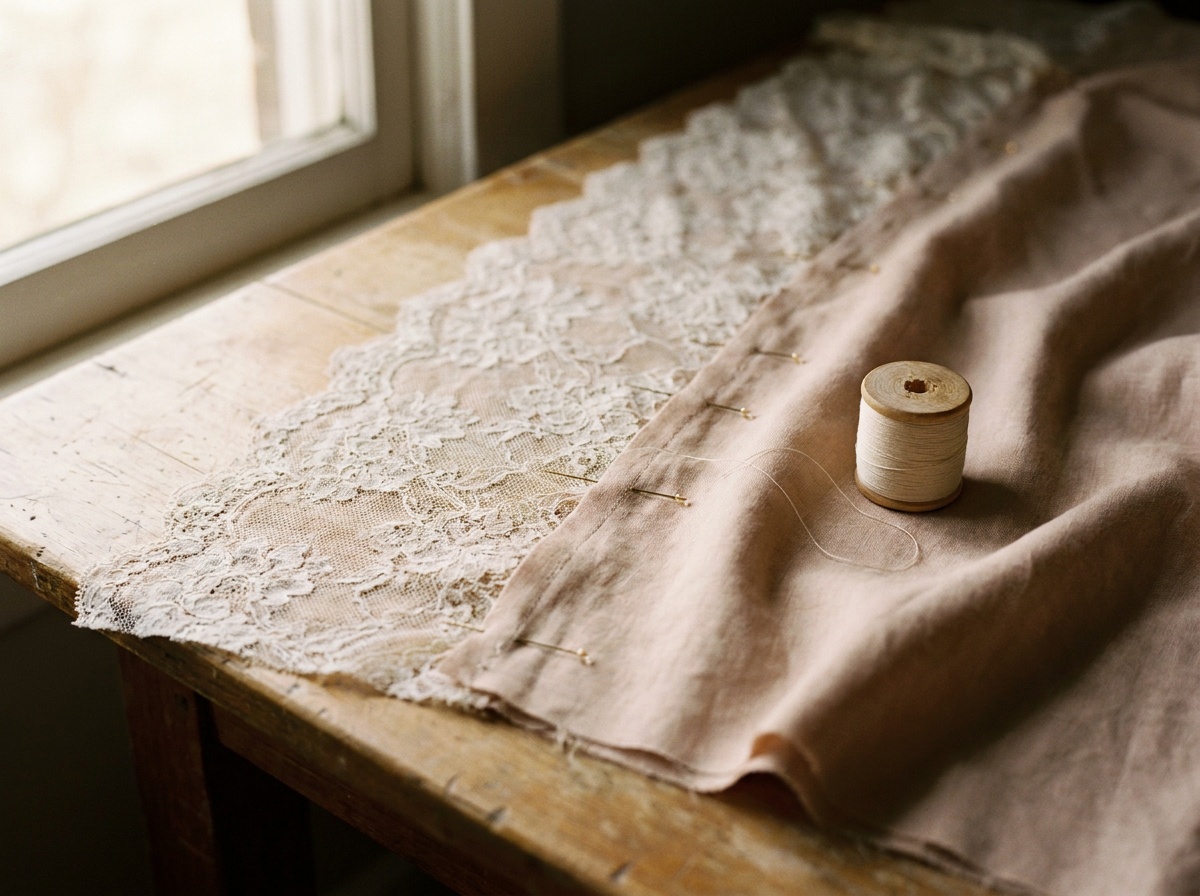
Lace covers many fabrics, so the first job is to identify what you have: a stable allover lace like chantilly, a firm motif lace like guipure, or a stretch raschel lace, because each is seamed differently. Most lace needs support: underline or line it, matching a stretch lining to stretch lace and a sheer or flesh-toned lining to stable lace. Seam allover lace with French or narrow serged seams, and where motifs are bold, overlap and hand-appliqué the seam so the pattern reads continuous rather than chopped. Stabilise shoulders and waists with fine stay tape or organza selvage, use a fresh fine needle (60/8 to 70/10) with pins only in the seam allowance, and make the most of the finished scalloped edge as a ready-made hem.
Lace is less one fabric than a family, and the technique follows the construction. Work out what you are holding first, then choose support, seams, and edges to suit it.
Identify the construction
Stretch and stability decide everything. Allover laces such as chantilly are soft and drape, and are usually underlined. Firm chemical or guipure laces hold their shape and can be cut around motifs. Stretch raschel lace behaves like a knit and needs stretch seams and a stretch lining. Handle a corner: if it recovers after stretching it is a stretch lace; if it stays put it is stable. The lace cloth profile covers the range of constructions in more detail.
Support it with underlining or lining
| Underline soft allover lace | Chantilly and similar soft laces are often underlined with a near-invisible sheer basted to each piece and treated as one layer, which stabilises the lace and carries the seams. |
| Match stretch to stretch | Stretch lace must be lined or underlined with a stretch mesh or lining, never a woven, or the seams will pop when the garment is worn. |
| Line for modesty and finish | A flesh-toned or contrast lining behind lace sets the look and hides construction. Bind or enclose seam allowances in skin-toned organza or mesh for an unlined finish. |
| Baste, do not pin through | Baste layers together around the edges with a generous allowance and treat as one piece, so the lace does not shift on the lining. |
Seam so the pattern survives
On lace with a prominent motif, a plain seam slices the pattern and leaves an obvious join. Instead, overlap the seamline of one piece onto the other, follow the edge of a motif, and hand-fell or narrow-zigzag around it so the pattern appears continuous and the seam disappears into the design. For allover pattern lace without bold motifs, a French seam (where the lace is not too bulky) or a narrow four-thread serged seam keeps things clean, and stretch lace wants a narrow zigzag so the seam gives. Test the chosen seam on a scrap first.
Support the seams that take strain. Stay the shoulders and waistline with fine stay tape, or with quarter-inch selvage cut from lightweight lining or flesh-toned silk organza, so the lace does not stretch out at the stress points. Start with a fresh sharp needle in a small size (60/8 to 70/10) and put pins only in the seam allowance, since pinholes show on the finished garment. For the wider seam-finish set see the seam finishes visual guide.
Use the scalloped edge
Many laces come with a finished scalloped edge along one selvage. Plan the layout so that edge falls at a hem, neckline, or sleeve end and you get a ready-made decorative finish with no hemming. Cut around the scallops rather than straight across, and appliqué the scalloped border over an adjoining piece for a couture edge.
Sources and decision boundaries
The construction, underlining, seaming, and edge methods here follow established references such as Threads Magazine on easy-to-sew lace, Charm Patterns on working with lace, and the BERNINA blog's tips for sewing with lace. Exact needle, seam, and support choices depend on the specific lace and its construction and are confirmed on a scrap, which this guide does not replace.
How do I know which lace I have and why does it matter?
Stretch a corner: if it recovers it is a stretch raschel lace and needs stretch seams and a stretch lining; if it stays put it is a stable lace like chantilly or guipure. Soft allover laces are usually underlined, while firm guipure can be cut around its motifs. The construction decides support, seams, and edges.
Do I need to line lace?
Usually yes. Soft allover lace is underlined with a near-invisible sheer for stability, stretch lace must be lined with a stretch mesh so seams do not pop, and a lining behind lace also sets the look and hides construction. For an unlined finish, enclose the seam allowances in skin-toned organza or mesh.
How do I seam lace without chopping the pattern?
On bold-motif lace, overlap the two seamlines, follow the edge of a motif, and hand-fell or narrow-zigzag around it so the pattern reads continuous. On allover lace, use a French seam where it is not too bulky, or a narrow serged seam, and use a narrow zigzag on stretch lace.
What should I do with the scalloped edge?
Plan the layout so the finished scalloped selvage lands at a hem, neckline, or sleeve end for a ready-made decorative edge that needs no hemming. Cut around the scallops rather than straight across, and appliqué the border over an adjoining piece for a couture finish.