How to Sew with Denim: Needles, Topstitching, and Thick Seams
Sew denim on a home machine: the heavy needle and topstitch thread to use, how to get the two-row jeans topstitching, flat-felled seams, and how to get over bulky seams without breaking a needle.
Established sewing references reviewed for needle and thread choice, stitch length, flat-felled seams, topstitching, and managing bulk when sewing denim on a domestic machine; no universal settings are prescribed and are confirmed on the specific denim weight.
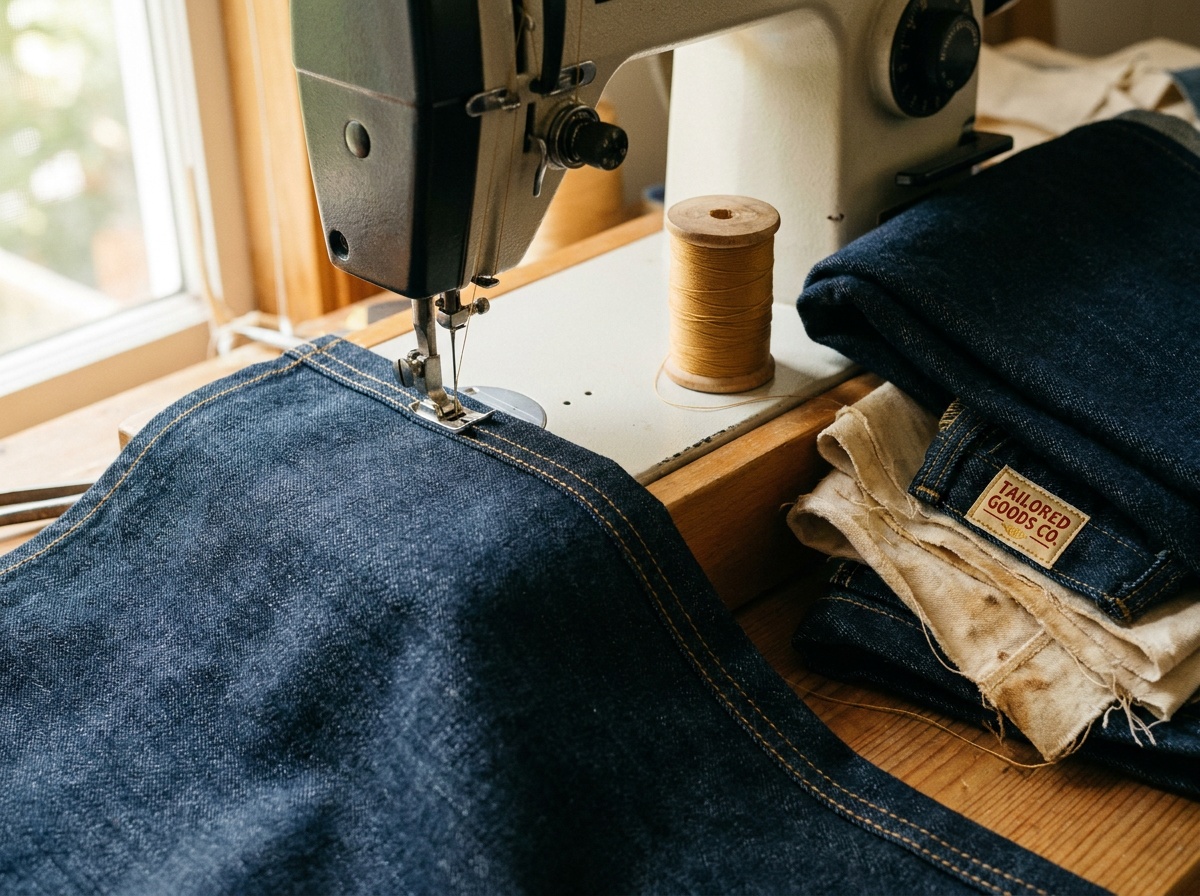
Denim is heavy and layered, so the machine needs the right hardware, not brute force. Fit a jeans or denim needle in 90/14 to 100/16 to match the weight, use a longer stitch of about 3.0 to 3.5, and topstitch with heavy topstitching thread on top and regular thread in the bobbin. For the classic jeans look and a hard-wearing seam, use flat-felled seams and two rows of topstitching. At thick seam junctions, flatten the bulk with a hammer or clapper first and hand-walk the needle over the hump so it does not deflect and break. Test on a doubled scrap before the real seam.
Denim is a sturdy cotton twill, and most trouble comes from thickness rather than the fabric itself: broken needles at seam crossings, skipped stitches, and puckering. Set the machine up for the weight and the layers stop being a problem.
Needle, thread, and stitch length
| Needle | A jeans or denim needle, 90/14 for lighter denim up to 100/16 for heavy. It has a strong shaft and a sharp point made to pierce dense twill. Start every project with a fresh one, since a dull needle is the usual cause of skipped stitches. |
| Thread | Regular all-purpose thread for the construction seams. For visible topstitching, use heavy topstitching or jeans thread on top and regular thread in the bobbin, unless you are on an industrial machine. |
| Stitch length | Lengthen to about 3.0 to 3.5. A longer stitch sits better in heavy fabric, avoids puckering, and gives topstitching the bold look denim wants. Tighten tension slightly on bulky seams. |
| Topstitch needle | For the topstitching pass, a topstitch needle has a larger eye that carries the thick thread without shredding it. |
Flat-felled seams for the jeans look
The seams on jeans are flat-felled: the allowance is folded under and stitched down so no raw edge shows and the seam is doubly secured, which is why they survive years of wear. You sew the seam, trim one side of the allowance, fold the wider side over the trimmed one, and topstitch it flat. Worked in a contrast thread it gives the signature twin lines of gold topstitching. It is the strongest common seam and fully encloses the edges. For the method and its variations, see how to select and validate a seam and edge finish.
Topstitching that looks right
For the jeans look, sew two parallel rows of topstitching, the first close to the seam and the second a consistent distance out. An edge-stitch or blind-hem foot with a guide keeps the lines even, which matters more than anything for a professional result, since wandering topstitching is the giveaway. Sew slowly and steadily, and where topstitching crosses a bulky seam, slow right down and hand-walk over it.
Getting over thick seams
Where seams cross, denim stacks up four or more layers and a needle driven at speed can deflect off the hump and snap. Flatten the bulk first with a few taps of a hammer or a tailor's clapper, wrapped in cloth to protect the fabric. Approach the hump slowly and turn the handwheel by hand to walk the needle over it stitch by stitch. A hump-jumper tool, a small shim that levels the presser foot, keeps the foot from tipping and the stitches from bunching at the step up.
A walking foot helps throughout by feeding the heavy layers together, and it is close to essential for a double-folded hem, where the fabric is thickest.
Sources and decision boundaries
The needle, thread, seam, and bulk-handling methods here follow established references such as the Closet Core flat-felled seam tutorial, the Seamwork flat-felled seam guide, and the Merchant and Mills denim guide. Exact needle size, stitch length, and tension depend on the denim weight and are confirmed on a doubled test scrap, which this guide does not replace.
What needle do I need to sew denim?
A jeans or denim needle, 90/14 for lighter denim and up to 100/16 for heavy. It has a strong shaft and a sharp point made for dense twill. Start with a fresh needle, since a dull one is the most common cause of skipped stitches in denim, and use a topstitch needle for the topstitching pass so its larger eye carries the thick thread.
What thread should I use for topstitching jeans?
Heavy topstitching or jeans thread on top for the visible rows, with regular all-purpose thread in the bobbin unless you are using an industrial machine. Use ordinary thread for the construction seams. Lengthen the stitch to about 3.0 to 3.5 so the topstitching reads bold.
How do I sew over thick denim seams without breaking a needle?
Flatten the bulk first with a hammer or tailor's clapper wrapped in cloth, then approach the junction slowly and turn the handwheel by hand to walk the needle over the hump one stitch at a time. A hump-jumper shim under the back of the presser foot keeps it level so the stitches do not bunch at the step up.
What is a flat-felled seam?
It is the seam used on jeans, where the seam allowance is folded under and topstitched down so no raw edge is exposed and the seam is stitched twice. It is very strong and hard-wearing, and worked in contrast thread it gives the classic twin rows of topstitching along the seam.