Honeycomb Cable
cables crossed toward and away from each other in alternating rows, forming an all-over honeycomb of interlocking twists
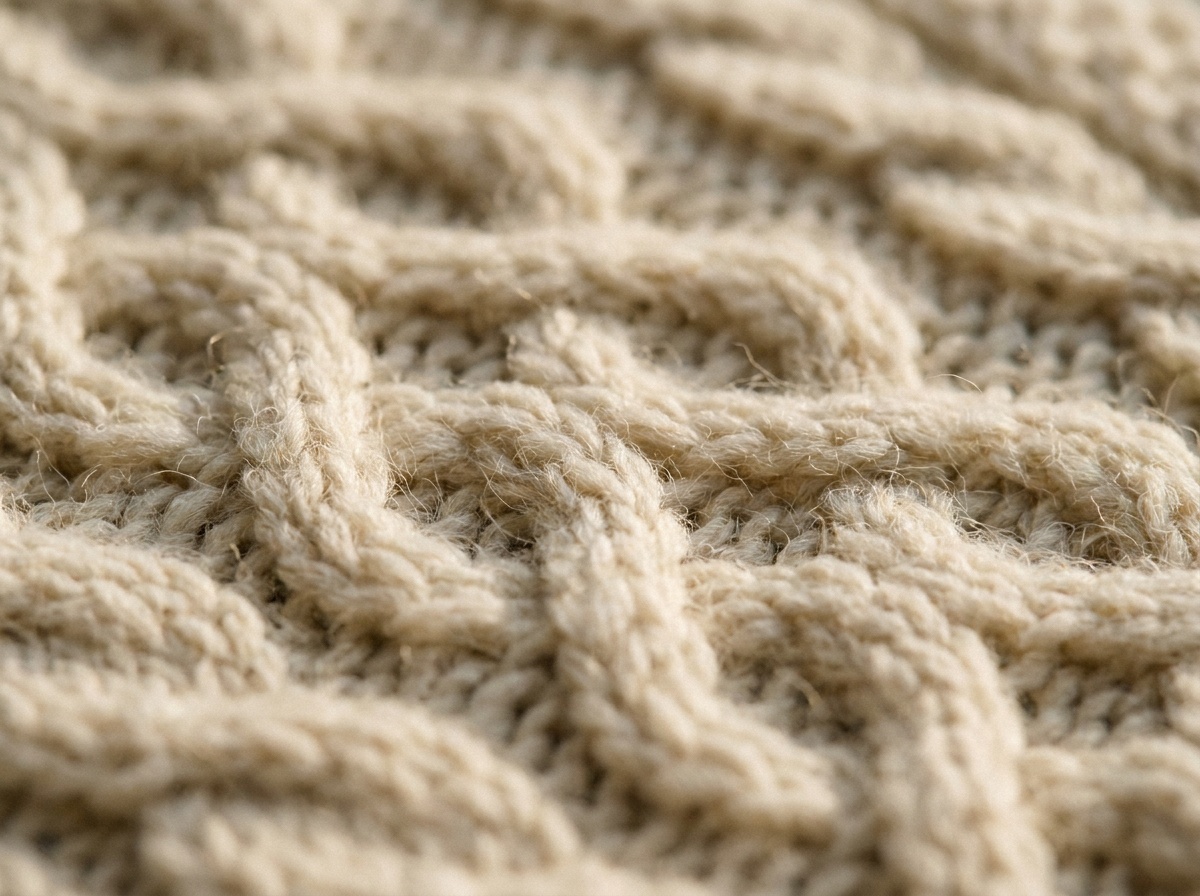
Honeycomb cable is an all-over cable panel that reads as a field of rounded, interlocking cells rather than a single rope running up the fabric. It is a staple of Aran knitting, where knitters filled whole sweater fronts with cabled texture. On the honeycomb, pairs of small cables lean toward each other on one crossing row and away from each other on the next, so the columns pinch in and bulge out in a repeating grid. The effect is a raised, three-dimensional surface that looks like stacked cells or a wickerwork of loops.
How it is built
The stitch is worked over a multiple of eight stitches on a background of stockinette. Each honeycomb column is a two-over-two cable, meaning you hold two stitches on a cable needle, work the next two, then work the held two.
The direction of the hold is what makes the pattern. On a front cross, you hold the cable needle at the front of the work, which slants the crossing to the left. On a back cross, you hold it behind, which slants it to the right. Honeycomb alternates these across a crossing row: cross front, cross back, cross front, cross back. A few plain stockinette rows separate each crossing row and let the twists round out. On the next crossing row, you reverse which pairs cross toward each other and which cross apart, so the cells that closed at the bottom now open at the top. That toward-and-away alternation, stacked up the fabric, is the honeycomb.
What the fabric does
Honeycomb pulls in hard. All those crosses shorten the fabric widthwise, so a honeycomb panel is narrower and denser than the same stitch count worked flat in stockinette. Swatch before you trust a pattern's width, and expect the fabric to be thick and warm: the crossings stack yarn on top of yarn, which is why Aran sweaters hold heat.
It is not reversible. The cells sit proud on the right side; the back is a muddle of stranded, distorted stockinette. The fabric has little sideways stretch because the cables lock it, though it blocks out somewhat under tension. Curl is minimal once the panel is wide, since the crossings anchor the edges, but a lone honeycomb strip on a stockinette ground will still curl at the sides like any stockinette.
What to use it for
Honeycomb earns its keep on structured, warm pieces where the texture is the point: fisherman and Aran sweaters, chunky cardigans, blanket squares, cushion fronts, and hats. Worsted or aran-weight wool with good stitch definition shows the cells best; a smooth, plied yarn beats a fuzzy or heavily variegated one, which hides the crossings. Use it as an all-over field or as a wide central panel flanked by simpler cables or moss stitch.
Do I need a cable needle for honeycomb?
For two-over-two crosses, most knitters use one. You can cable without a needle by slipping stitches off and catching them, but honeycomb has many crossings per row, so a cable needle keeps live stitches from dropping.
Why does my honeycomb look flat instead of raised?
Usually too few plain rows between crossing rows, or yarn that lacks body. Give the crosses room to round out, and switch to a firmer plied wool.