Eyelet Stitch
small deliberate holes made with a yarn-over and a decrease, the simplest lace, arranged in rows or motifs
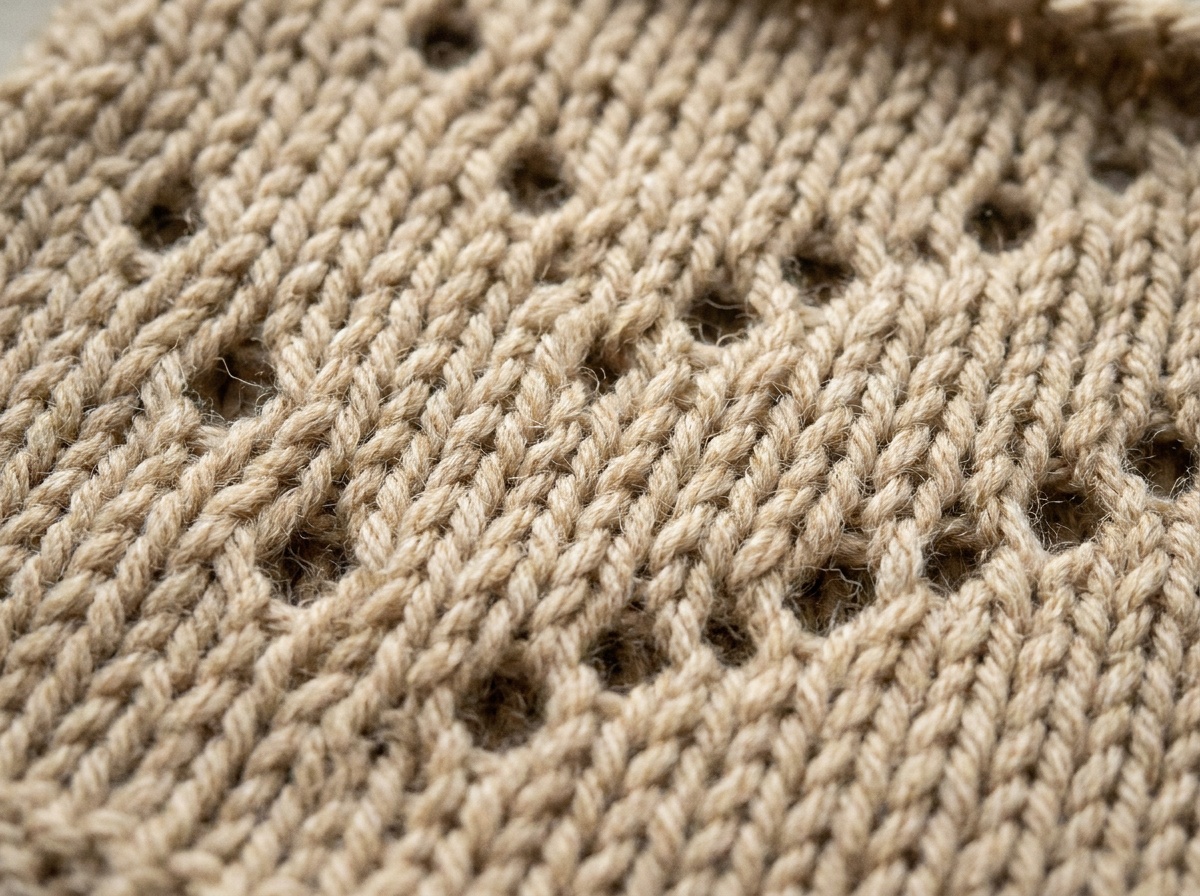
An eyelet is a small, deliberate hole in knitted fabric, made by pairing a yarn-over with a decrease. It is the simplest form of lace: one hole at a time, spaced across a row or arranged into a motif. Once you can work a yarn-over cleanly and read where the compensating decrease goes, you have the whole family of eyelet patterns, from a single row of holes along a hem to allover mesh.
How it is built from knit and purl
The hole itself comes from a yarn-over: you wrap the yarn over the right needle without working into a stitch, which adds one loop. On the next row that loop is worked like any other stitch, and the strand it leaves behind opens into a small round gap.
A yarn-over on its own adds a stitch, so an eyelet almost always carries a decrease to keep the count steady. The standard pairing is a yarn-over next to a knit-two-together (yo, k2tog): the k2tog removes the stitch the yo added, and the two lean into each other so the hole sits open and defined. Work them as neighbors on a background of stockinette or garter, and each pair reads as one clean eyelet. Change the decrease and you change how the hole tilts: k2tog pulls it right, ssk pulls it left, and a centered double decrease frames a hole with stitches leaning in from both sides.
Spacing is what turns eyelets into a pattern. A single yo, k2tog repeated every few stitches gives a row of holes, useful for a drawstring or ribbon casing. Stack the repeats and stagger them row to row and the holes start to relate to each other, which is where eyelet shades into proper lace.
What the fabric does
Eyelet fabric behaves like its background with holes punched through it. On stockinette it curls at the edges the way plain stockinette does, so an eyelet panel still wants a border of garter, ribbing, or a hem to lie flat. On garter or seed stitch it stays flat on its own.
The holes add stretch and openness without making the fabric flimsy. A light scatter of eyelets keeps most of the fabric's body while letting air and light through, which is why the stitch suits warm-weather garments and baby knits. Reversibility depends on the ground: eyelets on garter look close to the same on both sides, while eyelets on stockinette have a clear right and wrong side. The fabric is thinner and airier than solid knitting, and blocking matters more than usual, since opening the holes evenly is what makes the pattern read.
What to use it for
Reach for eyelets when you want openness with structure: summer tops and tees, shawls, baby blankets and cardigans, and lacy edgings on an otherwise plain piece. A single functional row of yo, k2tog makes a tidy eyelet casing for a drawstring, ribbon, or elastic at a waist, cuff, or bonnet edge. Because eyelets are the gentlest step up from plain knitting, they are also the natural place to start if you want to move toward lace without committing to a full charted pattern.
What is the difference between an eyelet and lace?
Scale and density. An eyelet is a single hole made from a yarn-over and a decrease. Lace is what you get when you repeat and arrange eyelets into an allover pattern, often with decreases that shape the fabric as well as make holes.
Why does a yarn-over always need a decrease?
A yarn-over adds a stitch. Pairing it with a decrease such as k2tog removes that added stitch, so your count stays constant and the holes sit where you placed them instead of the fabric growing wider each row.
Why did my eyelet disappear?
Usually the yarn-over was dropped or worked together with a neighboring stitch on the return row. Treat the yo loop as a normal stitch on the next row and the hole will hold open.