How to Build a Bill of Materials (BOM)
Build the apparel BOM that drives sourcing, costing, and compliance: every fabric, trim, thread, label, and packaging item with placement, spec, consumption, supplier, and colourway — nothing left to assumption.
Reviewed apparel BOM references, the US FTC textile and care-labeling rules, and the fabric mass-per-area method for the components a BOM must capture and the labels it must include; item codes, quantities, consumption, suppliers, colourways, and costs are product-specific and require validation, and no prices are prescribed.
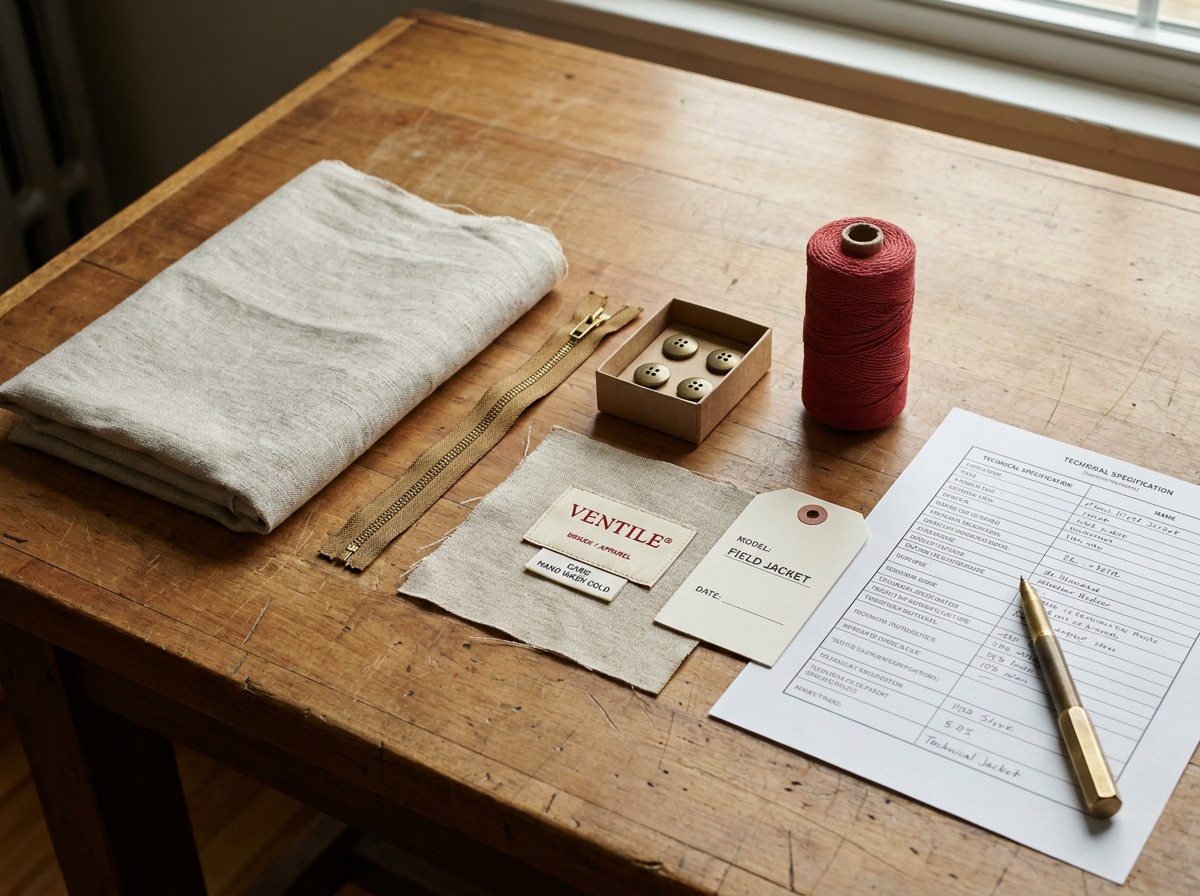
A Bill of Materials (BOM) is the complete, itemised list of every material that goes into a style: face fabrics, linings, interlinings, thread, trims and findings, and every label and packaging component, each with its placement, specification, colourway, consumption or quantity, unit of measure, supplier and reference, and cost. It is the most cost-sensitive document in development, because materials are commonly 60 to 70 percent of a garment's cost, and the single most common cause of a wrong quote or a stalled order is a BOM that is missing a line, vague on a spec, or silent on the required labels. Build it so a stranger could source and cost the garment from the document alone, tie fabric consumption to measured fabric data rather than a guess, and include the legally required content and care labels as line items.
The BOM is the backbone of the tech pack: patterns and construction tell a factory how to build the garment, and the BOM tells them what to buy to build it. If it is incomplete, everything downstream — the quote, the order, the compliance of the finished label — is built on a gap.
What a complete BOM contains
| Fabrics | Face fabric(s), linings, interlinings, and any pocketing or fusible, each with fibre content, construction, weight, width, and finish. Fabric is usually the largest single cost, so its spec and consumption drive the quote. |
| Thread and findings | Sewing and topstitch thread, plus elastic, drawcord, boning, and anything consumed in construction. Easy to forget and cheap per unit, but each carries a colour, a placement, and attaching labour. |
| Trims and closures | Zips, buttons, rivets, snaps, hook-and-bar, eyelets, cord stops, tape, and appliqué, with size, type, finish, and placement. |
| Labels | Brand, size, content, and care labels, plus any market-compliance label. These are not optional decoration: content and care labels are legally required in many markets and belong on the BOM as controlled line items. |
| Packaging | Hangtags, polybags, tissue, cartons, stickers, and any silica or hanger, each with spec and quantity. Packaging is part of the landed cost and the retail presentation. |
Complexity scales with the garment: a basic tee may run roughly 8 to 12 line items, a hoodie or dress 15 to 20, and a tailored or technical outerwear piece 25 to 50 or more.
What each line item must carry
| Item, placement, and specification | What it is, where it goes on the garment, and its full spec (size, type, fibre, finish). 'Button' is not a line item; '18L four-hole matte-black corozo button, front placket, 7 per garment' is. |
| Supplier and reference | The nominated supplier, the supplier's article or colour code, and any internal material code, so the same material is bought consistently across factories and seasons. |
| Colour and colourway | The colour of each item in each colourway of the style, since one style in three colourways is effectively three BOMs for colour-carrying items. |
| Consumption or quantity and unit | How much per garment, in the correct unit (metres of fabric, pieces of trim, metres of thread), including an allowance for waste. Fabric consumption in particular must be estimated from the marker and measured fabric, not guessed. |
| Cost (where known) | The unit cost and the extended cost per garment, which is what makes the BOM the input to the cost sheet. Leave it explicitly blank rather than assuming when unknown. |
Tie fabric consumption to real data
Because fabric is the biggest cost, its consumption is where a BOM most often goes wrong. Consumption is not the area of the pattern pieces; it is the fabric the marker actually uses, including the waste between pieces, and it rises with bias cuts, one-directional naps, prints that must match, and narrow widths. Estimate it from the marker and the measured fabric width and mass, not a round number. The mass-per-area of the fabric is a measurable property with a defined method (ASTM D3776), and a wrong assumption there scales straight into the quote. Pair this with the fabric weight converter and fabric purchase planner for the arithmetic, and feed the result into the garment cost sheet.
Labels are compliance, not an afterthought
| Required by law in many markets | In the US, fibre content and care information are required on the garment (FTC textile rules and the Care Labeling Rule, 16 CFR part 423); other markets have their own requirements. A missing or wrong label is a compliance failure, so the labels must be controlled BOM line items, not a late addition. |
| Set by the whole product | The care instruction is driven by the least tolerant component, so it depends on the rest of the BOM. See the [care symbols and labelling systems guide](/guides/care-symbols-and-labelling-systems) and the [care and content label product example](/guides/care-and-content-label-product-example). |
| Placement and construction | Each label has a position, an attachment method, and a size that affect pattern and construction, so it carries the same detail as any other trim. |
Bill of materials record
Bill of materials (BOM) record
One controlled record per style, expanded per colourway for colour-carrying items, so a stranger could source and cost the garment from the document alone.
Saved in this browser only, never sent to a server.
Style header
Line items (repeat per material)
Every fabric, thread, finding, trim, label, and packaging item is a line.
Labels and compliance
Control
Sources and decision boundaries
The components, line-item fields, and label requirements here follow apparel BOM references such as the NetSuite guide to the BOM in fashion and Fashion Index on crafting a BOM; the required content and care labels follow the US FTC Care Labeling Rule, 16 CFR part 423 and FTC textile and wool labeling guidance, and fabric consumption rests on the measurable mass-per-area method (ASTM D3776). Item codes, quantities, consumption, suppliers, colourways, and costs are product-specific and require validation; this guide does not prescribe materials, quantities, or prices for any specific product, and label compliance depends on the destination market.
Work with a technical designer.
Before you send a style out to quote, read the BOM as if you were the factory buyer: could you order every item from this document without a single question? Every question you would have to ask is a line the BOM is missing, and every one of those is a delay or a wrong price later.
FAQ
What is the difference between a BOM and a tech pack?
The BOM is one part of the tech pack. The tech pack as a whole specifies the garment — measurements, construction, artwork, labels, and the BOM — while the BOM specifically lists every material to buy, with placement, spec, quantity, supplier, colourway, and cost. Patterns and construction say how to build it; the BOM says what to buy.
Why is the BOM so important for cost?
Because materials are commonly 60 to 70 percent of a garment's cost, so the BOM is the most cost-sensitive document in development. A missing line, a vague spec, or a wrong fabric consumption moves the quote directly, and the BOM is the input the cost sheet is built from.
Do labels really belong on the BOM?
Yes. Content and care labels are legally required in many markets, and every label has a spec, placement, attachment, and cost like any other trim. Treating them as controlled BOM line items rather than a late addition is what keeps the finished garment compliant and correctly costed.
How do I handle multiple colourways in a BOM?
Every colour-carrying item — fabric, thread, trims, sometimes labels — repeats per colourway, so one style in three colourways is effectively three BOMs for those items. Non-colour items are shared. Structure the record so each colourway's colours are explicit rather than assumed.