Worked Example: Yarn-Dyed Poplin Button-Up Shirt
An editable adult woven-shirt record showing how usable width, stripe repeat, matching, fusing, shrinkage, bow and skew, buttons, and appearance change the brief.
Primary standards-owner and United States regulator sources reviewed for the example's woven-material, width, bow and skew, seam, laundering, colorfastness, and labeling prompts; all values remain illustrative rather than approved specifications.
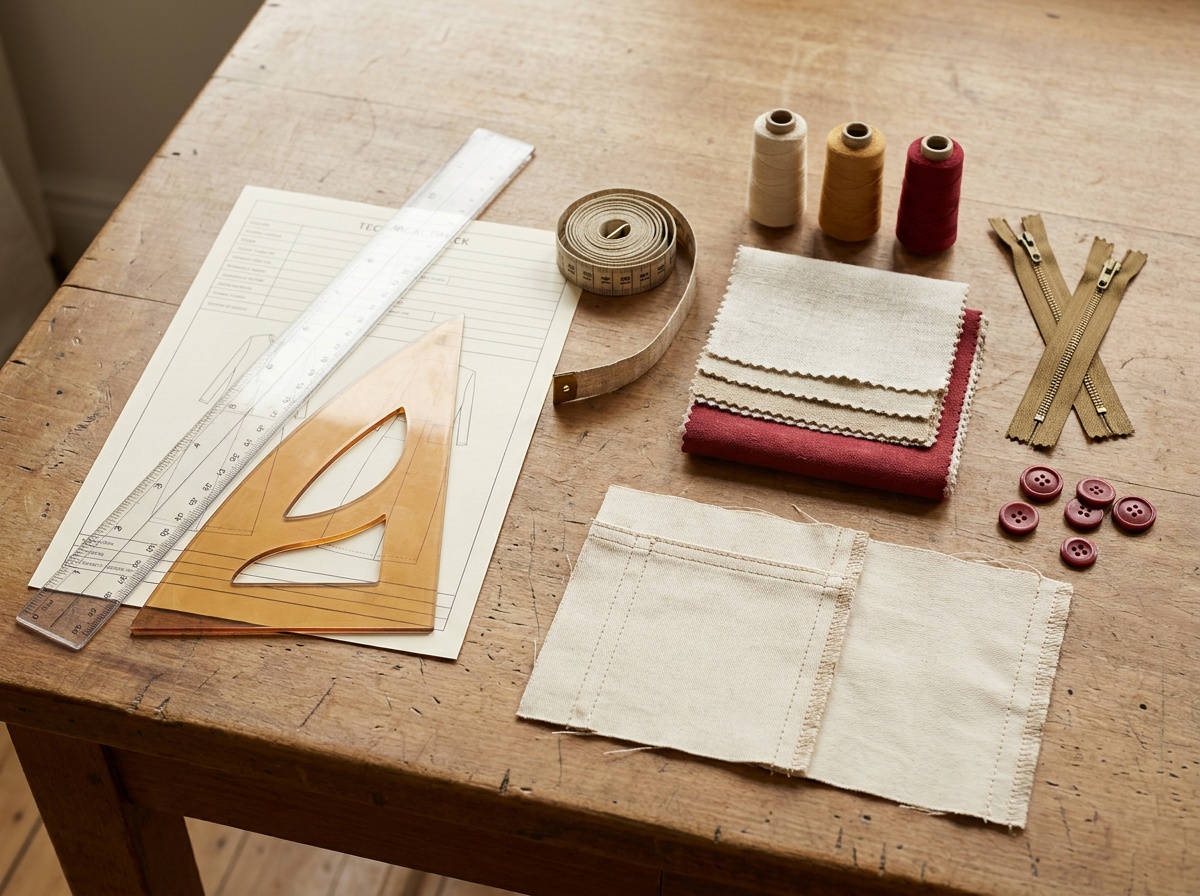
This is an illustrative decision record for an adult long-sleeve button-up shirt sold in the United States: a yarn-dyed striped cotton poplin shell with fusible interlining, buttons, thread, labels, and packaging. It shows why a woven-shirt brief must connect usable width and stripe repeat to yield and marker planning; bow, skew, shrinkage, fusing, seam and button performance to appearance; and pattern placement to a written matching standard. The values are fictional starting assumptions, not industry pass values or compliance advice.
Freeze the scenario and visual standard
| PRODUCT | Adult long-sleeve button-up shirt, regular fit, patch pocket |
| MARKET | United States direct-to-consumer; adult product only |
| SHELL | Illustrative yarn-dyed striped 100% cotton poplin, 120 g/m² nominal |
| WIDTH | Illustrative 145 cm usable width; supplier result and tolerance required |
| COMPONENTS | Fusible interlining, buttons, sewing thread, labels, packaging |
| DECISION | Qualify material, lock placement rules, and approve one production route |
The nominal mass and width are invented. Usable width must be measured and reconciled with selvages, repeat, marker, cutting method, matching allowance, defects, and order mix. Use the blank Material Sourcing Request, Supplier Screening Brief, and Sample Review & Approval Record for the live program, then publish the controlled construction and placement decisions through the tech pack.
Why this woven changes the master brief
The headline composition does not tell a pattern maker where a stripe begins, a marker planner how much matching allowance is needed, or a factory which intersections must align. Record repeat in both directions, reference stripe, face side, nap or one-way restriction if any, panel orientation, center-front relationship, pocket placement, yoke decision, sleeve pairing, acceptable discontinuities, and the approved visual reference.
ASTM D3774 addresses fabric width and distinguishes usable width from the full width under defined conditions. ASTM D3882 addresses bow and skew in woven and knitted fabrics. These methods can help make the request observable, but they do not create one shirt-specific tolerance or matching rule.
This adult shirt example is not reusable unchanged for childrenswear, sleepwear, flame-resistant apparel, uniforms with contractual specifications, protective clothing, or another destination market. It does not determine legal, flammability, chemical, labeling, test, inspection, or care requirements. Interlining, buttons, finishes, and decorations can introduce separate risks that need qualified review.
Edit the worked decision record
Every prefilled statement is either an illustrative assumption, a process choice to confirm, or an open item. Replace it with controlled evidence. Reset restores the example only.
Adult yarn-dyed poplin shirt decision record
Turn a striped woven concept into measurable material, placement, fusing, construction, sample, and bulk controls. Preserve the difference between a visual reference, a measured result, and a pass requirement.
Edits stay in this browser page and are not saved or sent. Illustrative values are not universal requirements.
Scenario and authority
Name the exact product, market, files, and decision owners.
Shell, repeat, width, and yield
The same fabric mass can produce a different garment cost and appearance when repeat, width, shrinkage, or placement changes.
Placement, matching, and pattern controls
Write what must align, what may float, and how each location is judged.
Performance and component evidence
Select methods because a failure matters to this product, then set limits with the accountable technical team.
Supplier route and sample gates
Make stripe, fusing, and construction capability observable before the order is exposed.
Labels, approval, and open risk
Close the record only to the product, route, evidence, and period actually reviewed.
Inspect against the written visual rule
A note that says “match stripes” is not inspectable. At each critical location, the record should state the datum, direction, reference stripe, garment state, observation or measurement method, tolerance or approved visual range, defect class if used, and who may accept an exception. Noncritical locations should also be named so an inspector does not invent a standard during final inspection.
Separate material inspection, cut-panel control, in-line construction review, pre-production approval, top-of-production review, and lot sampling. One perfect sales sample does not prove repeat placement, shade consistency, fusing durability, or shipment defect rate.
Sources and decision boundaries
The material prompts use current primary descriptions of ASTM D3776/D3776M for fabric mass, ASTM D3774 for fabric width, ASTM D3882 for bow and skew, AATCC TM135 for fabric dimensional change, and AATCC TM150 for garment dimensional change. AATCC TM8 and AATCC TM61 inform the crocking and accelerated-laundering prompts. ISO 4916 and ISO 4915 provide controlled seam and stitch terminology.
For this fictional United States sale, the labeling prompts point to the FTC's current textile and wool labeling guidance and Care Labeling Rule guidance. These sources support the questions and evidence structure. They do not give Stitch Authority authority to select universal tolerances, reproduce paid methods, validate a care instruction, or declare a shirt compliant.