Sample Review & Approval Record
A fillable review record for garment and sewn-product samples, with version control, measurements, materials, construction, defects, corrections, and production disposition.
Primary standards-owner sources reviewed for lot sampling, measurement and laundering evidence, and controlled approval records; the template does not select an AQL plan, acceptance value, or product-specific compliance requirement.
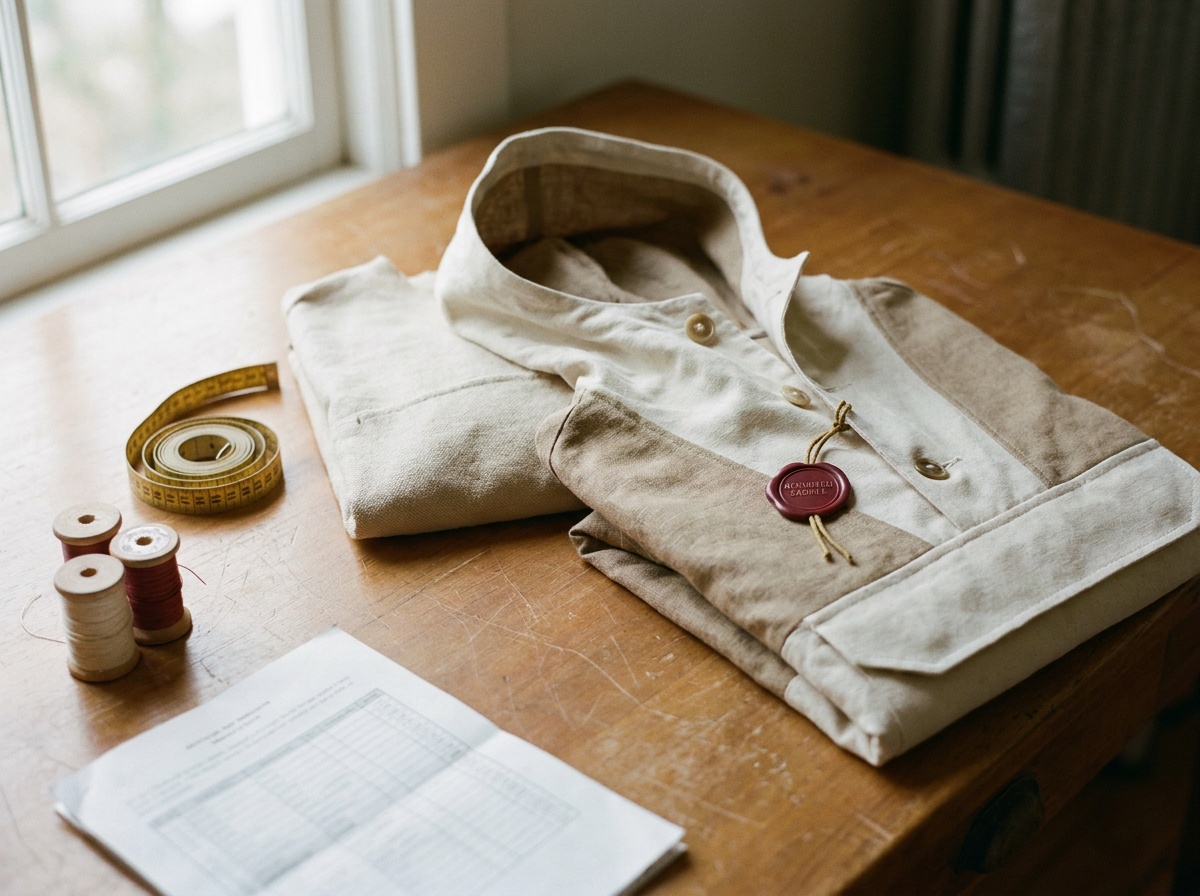
Approve a sample only by its unique identifier, stage, date, specification version, material lots, color, size, and production route. Review measurements, fit or function, material and trim identity, color, construction, workmanship, performance evidence, labeling, packaging, and every open exception. Then issue one unambiguous disposition: approved for the named next step, approved with written conditions, revise and resubmit, or rejected. Approval of one sample does not approve bulk production or shipment unless the record explicitly says what it controls.
Name the sample's job before reviewing it
Different sample stages answer different questions. Teams use stage names differently, so the purchase order or development calendar should define them. A practical starting point is below.
| Prototype or development | Tests concept, construction, proportion, or feasibility; materials and workmanship may not represent production |
| Fit | Tests fit and measurements on a named size, body, form, or avatar; it does not prove the full size range |
| Size set | Checks selected sizes and grading relationships; the reviewed sizes and fit method must be recorded |
| Pre-production | Checks the production-ready specification, materials, methods, facility, and approvals before bulk starts |
| Top of production | Checks units taken from early bulk production against the approved standard; it is not a statistically representative shipment inspection by itself |
| Shipment or inspection sample | Supports a defined lot inspection or test plan; the sampling scheme and acceptance rules must be agreed in advance |
Use the field that matches the actual decision, not the most impressive stage name. If a pre-production sample uses substitute fabric or is made in a development room instead of the declared factory line, record the limitation and require the missing verification.
Sample review and approval record
Complete one record per physical or digital sample version. Photograph and retain the reviewed item when appropriate, and attach every comment to a measurable location, requirement, owner, and disposition.
Nothing entered here is saved or sent.
Sample identity and custody
A decision is only reproducible when everyone can identify the exact item that was reviewed.
Authoritative inputs
Freeze the reference set before measuring or commenting.
Measurement review
Record the method, target, tolerance, result, and delta. Do not approve from appearance alone.
Fit, function, and user review
Name the body, form, user, movement, duration, and limits of the review.
Material, color, and trim review
Confirm identity and behavior, not only visual similarity.
Construction and workmanship
Review against explicit construction and defect definitions.
Performance, care, and test evidence
A report must identify the tested sample, method, conditions, result, and acceptance limit.
Labels, packaging, and shipment readiness
Complete the fields relevant to this stage and destination market.
Defect and correction log
Define severity before inspection and connect each issue to a correction and verification.
Disposition and production control
Issue one decision with a named scope. Avoid comments such as 'looks good' or 'okay to proceed' without conditions.
Closeout and next submission
Preserve the evidence trail so the next sample starts from the approved record.
Approval is not inspection by sampling
A pre-production or top-of-production sample can be an important production control. It still does not reveal the defect rate of an entire lot. If the shipment decision will use acceptance sampling, record the chosen standard or plan, lot definition, inspection level, defect classes, AQL or other index, sample size, acceptance and rejection numbers, switching rules, and who has authority to hold or release the lot.
The current ISO 2859-1:2026 defines AQL-indexed sampling schemes for continuing lot-by-lot inspection and includes normal, tightened, reduced, and skip-lot procedures. ANSI/ASQ Z1.4 also uses switching rules for a continuing stream of lots. Neither source establishes one universal apparel setting. The plan must be chosen for the product, defect consequence, supplier history, contract, inspection context, and producer and consumer risk.
This record does not validate fit across a population, approve unreviewed colors or sizes, prove that bulk matches a sample, determine a universal defect severity or AQL, replace laboratory testing or shipment inspection, or establish legal compliance. Digital samples and photographs can support review but cannot prove every physical property. Use qualified technical, quality, safety, compliance, and legal review where the consequence warrants it.
Sources and decision boundaries
The measurement and care-evidence fields reflect the need for controlled methods, conditions, and sample identity. ASTM's D3776/D3776M notes that a small swatch result applies to the sample and not necessarily to its lot. AATCC TM135 defines controlled procedures for determining fabric dimensional change after home laundering. Those distinctions are why this record separates a reviewed item from bulk and requires lot-linked test evidence.
For shipment sampling, ISO 2859-1:2026 and ASQ's Z1.4 overview support documenting the complete sampling scheme rather than writing “AQL inspection” without its inputs. This worksheet translates those control principles into a review record; it does not reproduce or replace the licensed standards.