Points of Measure (POM) Explained, with Standard Charts
What a point of measure is, the abbreviations factories use, and how a POM chart is built for a basic top.
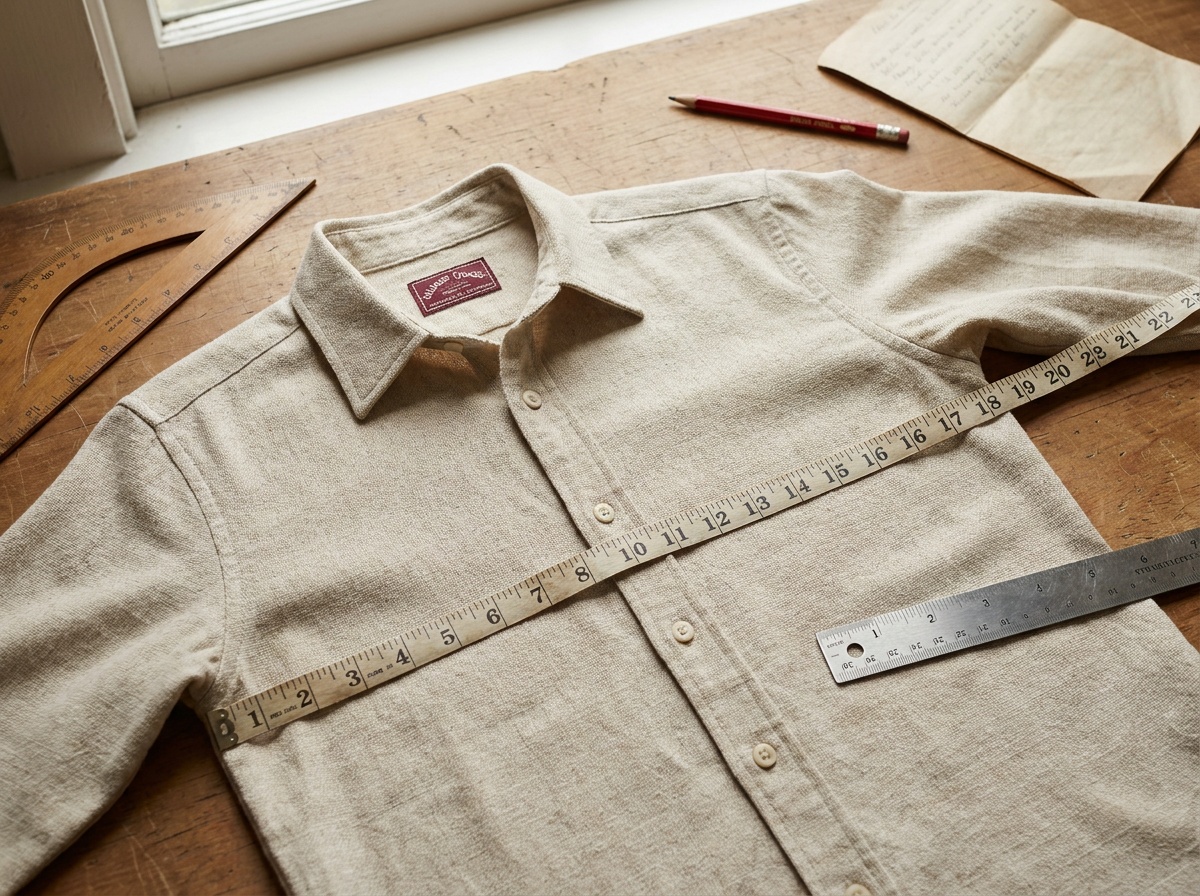
A point of measure (POM) is a defined location on a garment where a specific measurement is taken, flat, on a table, not on a body. A tech pack's spec sheet is built entirely from POMs: each one gets a code, a plain-language description of where and how to measure it, a tolerance, and a target value per size. There's no official standards body that assigns POM codes or names. Abbreviations like HPS, CF, and CB are near-universal through convention, not through a governing rule, which is why the description column matters as much as the code.
A tech pack's grade sheet is a list of POMs. Get the list wrong, incomplete, or ambiguously described, and the factory either guesses or asks for a revised tech pack, either way costing a sampling round. This page covers what a POM is, the codes and terms you'll see on a real spec sheet, how measuring method changes the number, and a reference chart for a basic crew-neck tee.
What a point of measure is
A POM does two jobs. During patternmaking, it's a location the pattern maker checks the draft against, referenced to a seam or landmark so it can be found the same way on every size. During quality control, it's a location a finished garment is measured at, flat on a table, and compared against the spec sheet's tolerance to decide pass or fail.
Both jobs need the same thing: a POM that any two people, in any two factories, measure the same way. That's why a spec sheet states not just a number but a method: where the tape starts, where it ends, and whether the garment is measured flat or stretched out.
Why there's no single official POM standard
Kathleen Fasanella, a patternmaking and production consultant whose Fashion-Incubator writing is one of the more credentialed independent references on this subject, has stated plainly that no standards body governs POM codes. HPS, CF, CB, and SS function as an industry-wide convention because enough factories and tech designers use them the same way, not because a certifying body enforces them.
That matters in practice: two spec sheets can use the same code to mean slightly different things, or different codes for the same measurement. The written description next to the code, not the code alone, is what a factory builds from. A spec sheet that relies on abbreviations without a description is asking for the same ambiguity a missing tolerance causes.
Standard abbreviations
| HPS | High Point Shoulder. Where the shoulder seam meets the neckline. The reference origin point most other tops measurements are taken from. |
| CF | Center Front |
| CB | Center Back |
| SS | Side Seam |
| AH | Armhole |
| NCK | Neck |
| SLV | Sleeve. Seen on some spec sheets, less universal than the codes above. |
| TM | Total Measure. Seen on some spec sheets, less universal than the codes above. |
Treat HPS, CF, CB, SS, AH, and NCK as close to universal. Treat SLV, TM, and any other code you encounter as a spec sheet's local convention until the description column confirms what it means on that particular sheet.
How a POM is measured: four methods
The same location on a garment can be measured a few different ways, and the method changes the number. A spec sheet should state the method, not assume it's obvious.
| Straight | Point to point in a straight line. Used for hem width, most lengths. |
| Curved | Along a seam's curve rather than a straight line. Used for armhole, sometimes collar. |
| Half circumference (flat) | Garment laid flat, side to side, edge to edge. The standard convention for chest, waist, hip, and sweep on tops. Double it to estimate the full circumference the body passes through. |
| Full circumference | Measured around, not laid flat. Less common on tops; used by some spec sheets for collars and waistbands. |
Most sources agree that circumference measurements on tops are conventionally stated as half measures, garment flat on a table, rather than full circumference. Practice isn't perfectly uniform on collars and waistbands, though: some spec sheets state those as full circumference instead. Confirm which convention a given spec sheet uses before comparing it to another.
A related distinction applies to anything with elastic: a waistband or cuff needs a spec for both its resting, flat state and its stretched-out state, because the garment has to fit correctly at both. A spec sheet for an elastic waistband commonly states both a "flat" and an "extended" (or "stretched") measurement rather than one number.
Common POMs for a basic top
These definitions are cross-checked across multiple technical-design sources and hold consistently for a crew-neck tee or similar knit top. Some, like where exactly "waist" falls below HPS, are brand-specific by design and stated here as convention, not universal fact.
| HPS | Reference point, not a measurement. Shoulder seam meets neckline. |
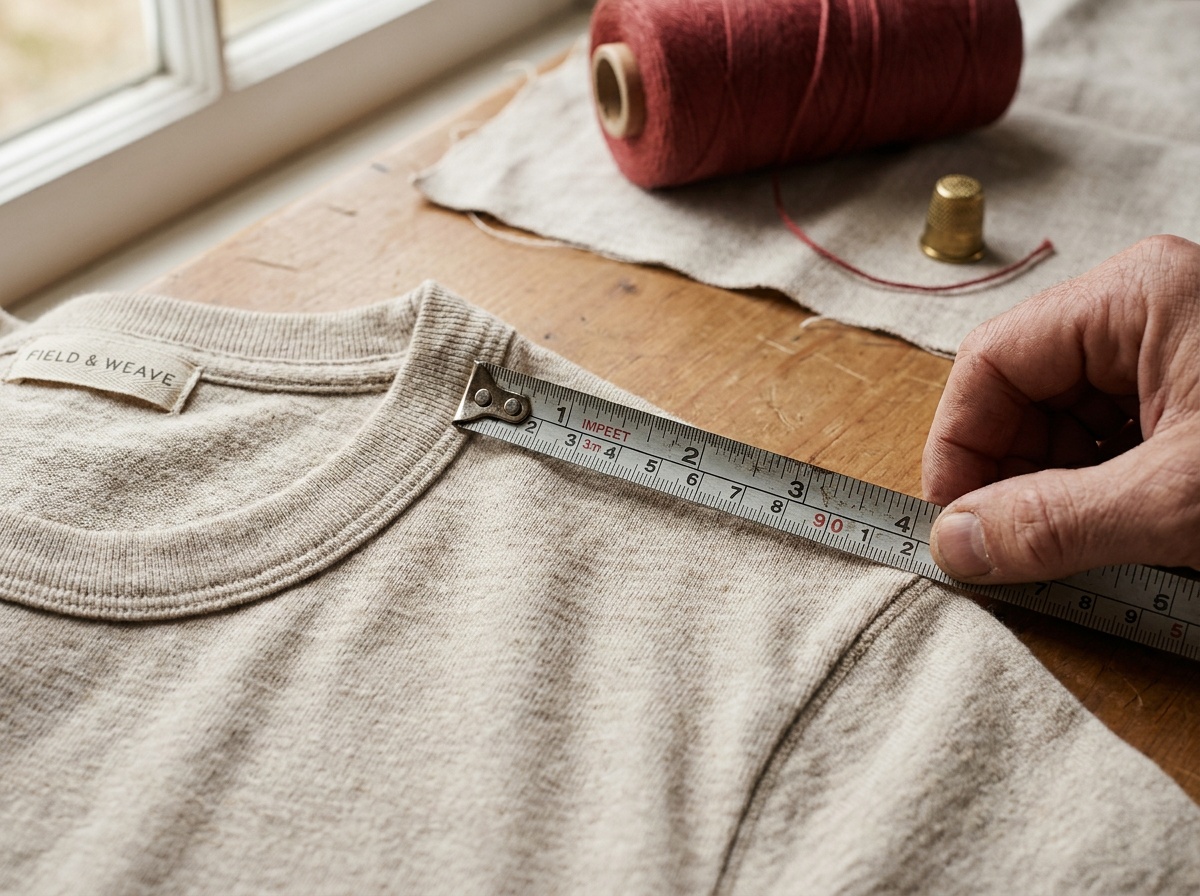
| Neck opening | Neck seam to neck seam, measured at HPS level, half measure. |
| Shoulder drop | HPS to the point where the shoulder seam meets the armhole. |
| Across chest | Side to side, roughly 1 inch below the armhole, half measure. |
| Body length | HPS straight down to the bottom hem. |
| Sleeve length | Shoulder seam to sleeve opening, for a set-in sleeve. Measured differently on a raglan. |
| Bicep | Roughly 1 inch below the armhole, perpendicular to the sleeve, half measure. |
| Armhole | Curved measure, from where it meets the side seam to where it meets the shoulder seam. Some spec sheets take it straight, point to point, instead. |
| Bottom sweep | Bottom edge, side to side, half measure. |
| Waist | Horizontal, side to side, at a distance below HPS set by the brand. Not standardized across brands. |
Tolerance, briefly
Tolerance, the acceptable plus-or-minus range around a target measurement, is covered in full in Tolerances in Apparel Manufacturing. The short version relevant to POMs: smaller, more fit-critical measurements (neck opening, cuff, collar) get tighter tolerance, and larger or less fit-critical measurements (body length, sweep) get looser tolerance. A commonly cited figure for a standard, fit-critical POM is around ±0.25 inch, widening toward ±0.5 inch for larger or less critical measurements. Sampling tolerance is also generally held tighter than bulk production tolerance, though no source gives a fixed universal ratio between the two.
One clean, checkable rule from that page applies directly to POM charts: tolerance should never run wide enough that adjacent sizes' spec ranges overlap. If a Small's half-chest is 18 inches and a Medium's is 19.5 inches, a tolerance of ±1 inch would let a Small measure 19 inches and a Medium measure 18.5 inches, an overlap. A tolerance of ±0.5 inch keeps the Small's ceiling at 18.5 and the Medium's floor at 19, with no overlap.
Spec sheet anatomy
A POM only becomes usable inside a spec sheet's full structure. That structure is close to identical across the sources reviewed for this page:
| POM code | Numeric or alphanumeric identifier. Brand-specific, no universal numbering system. |
| Description | Plain-language instruction: where the measurement starts, where it ends, flat or curved. |
| Tolerance | Stated as plus-or-minus, per POM, not applied uniformly across the sheet. |
| Measurement per size | The graded target value for each size in the range. |
| How-to-measure reference | A sketch or photo showing the tape placement. Written descriptions alone get read inconsistently across factories. |
POMs also get checked at multiple points in development, not just once. A spec sheet gets revisited and updated after fit comments come back at the proto, fit, size-set, and pre-production sampling stages, each round tightening the match between spec and finished garment.
Work with a technical designer.
Writing a POM chart for the first time is where a lot of first samples go wrong, usually from an ambiguous description rather than a wrong number. A technical designer can check that every POM on your sheet is described the way a factory reads it, before it's sent.
What does POM stand for?
Point of Measure. It refers to a specific, defined location on a garment where a measurement is taken, used both to check a pattern and to quality-control a finished garment.
Is there an official list of POM codes every factory uses?
No. Codes like HPS, CF, CB, and SS are near-universal through convention, but no standards body assigns or enforces them. Two spec sheets can use the same code slightly differently, which is why the written description matters as much as the code.
Why are circumference measurements on a spec sheet usually half the number you'd expect?
Because they're conventionally measured flat, on a table, edge to edge, rather than around the full circumference. A 20-inch chest measurement on a tee's spec sheet usually means the garment measures 20 inches laid flat, roughly 40 inches around.
Does every garment use the same set of POMs?
No. Tops and bottoms use different POM sets, and a tailored jacket needs more POMs than a basic tee. The POMs are chosen to match how the specific garment is constructed.
Where do I find the measurement values themselves, not just the POM definitions?
Those are specific to your garment, your fit model, and your base size. This page covers what each POM is and how it's measured. See How to Build a Size Chart From Scratch for how the actual numbers are set and graded across sizes.
Reviewed by Karolyn, Technical Apparel Designer · kellyhouse.studio