Tolerances in Apparel Manufacturing
What a tolerance is on a spec sheet, the ranges factories work to, and why the number matters more than founders expect.
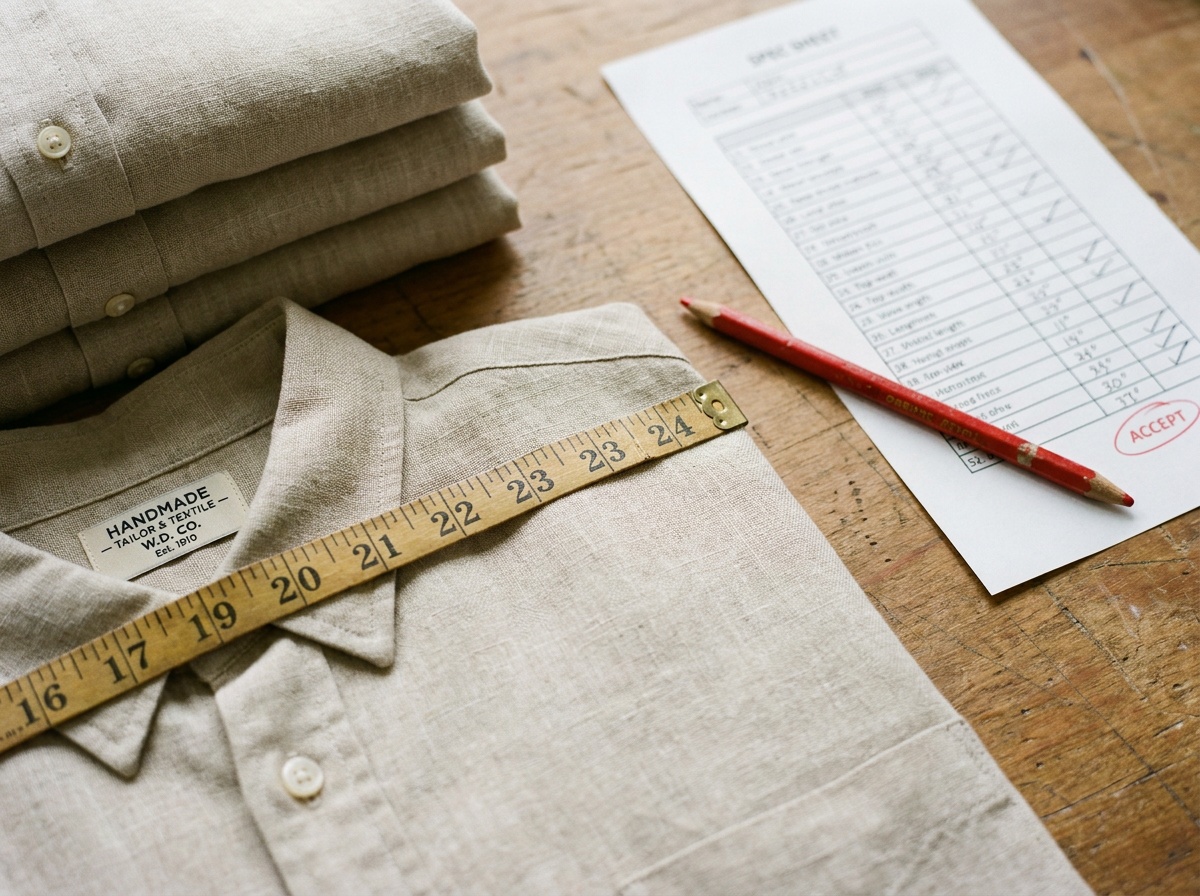
A tolerance is the acceptable range of deviation, plus or minus, from a target measurement on a spec sheet. Factories state it because no cutting, sewing, or pressing process hits a target with zero variance across a production run. A tighter tolerance means a more consistent fit and a higher reject rate. A looser one means fewer rejects and less consistent fit. There is no single correct number, and no external standard sets one for you.
A tech pack that lists measurements without tolerances is an incomplete tech pack. The factory will still cut and sew the garment, but without a stated range, quality control has no defined line between a pass and a fail. Someone decides that line anyway, and it's better if that someone is you.
What tolerance means on a point of measure
Every measurement on a spec sheet, chest width, sleeve length, waist, is a target, not a guarantee. Fabric relaxes after cutting. Stacks of fabric shift slightly under a cutting blade. Operators sew with small, unavoidable variance. Pressing changes dimensions again. A tolerance states how far a finished garment can drift from the target before it's rejected at inspection.
Two related terms get confused with tolerance. Separating them first makes the rest of this page easier to follow.
Grading is the rule for how a measurement changes from one size to the next, for example a chest width that grows by 1.5 inches per size step. Grading and tolerance are independent settings, but tolerance has to stay smaller than the grade increment or sizes start to overlap. A Large's smallest acceptable chest measurement can end up equal to a Medium's largest acceptable one, and at that point the two sizes are no longer reliably distinct on the QC floor. If a garment grades in 1.5 inch increments, a tolerance approaching or exceeding ±0.75 inches per side puts you at that boundary.
Seam allowance is a construction spec, not a measurement tolerance: the strip of fabric between a seamline and the raw edge. Mass-market production commonly runs 3/8 inch to 1/2 inch; home-sewing patterns default to 5/8 inch; couture and tailored construction often runs wider to leave room for alterations. It affects how a pattern is cut, not how far a finished measurement is allowed to drift. The two terms sound alike and aren't.
Tolerance and AQL (Acceptable Quality Limit) both get checked at inspection, but they answer different questions. Tolerance governs how far off any single measurement can be. AQL is a statistical sampling standard, most commonly run under ISO 2859-1, the successor to the older US military standard MIL-STD-105E, that governs how many garments in a shipment get inspected and how many defects are allowed before the whole lot is rejected. AQL 1.5 is strict and typical for babywear or safety-critical goods. AQL 2.5 is the standard used for most general apparel. AQL 4.0 is more relaxed and typical of lower-cost or promotional goods. A lower number means stricter inspection. The sample size and defect allowance scale with the size of the order under ISO 2859-1's lookup tables, so treat any specific figure you see quoted as an example, not a fixed rule, and let a QC inspection firm run the actual calculation for your order.
Typical tolerance ranges by garment and measurement type
No standards body sets these numbers. AQL sampling has ISO 2859-1 behind it; dimensional tolerance doesn't have an equivalent. It's set by the brand and agreed with the factory, and published ranges vary because sources are describing house practice, not a universal rule. The ranges below are a reasonable starting point, drawn from published factory and brand standards, not a spec you can skip negotiating.
| Fitted woven (dress shirt, tailored trouser) | ±0.25 in / ±0.6 cm |
| Standard casual woven (chinos, woven jacket) | ±0.5 in / ±1.27 cm |
| Casual knit (t-shirt, sweater) | ±0.5 to ±0.75 in / ±1.27 to 1.9 cm |
| Relaxed outerwear or knitwear | ±0.75 to ±1 in / ±1.9 to 2.5 cm |
A commonly cited figure for standard casual wear is ±0.5 inch (about 1.27 cm). A separate figure of ±2 cm shows up as an international norm in UK-based sourcing references. The two aren't in conflict once you account for rounding between imperial and metric convention (0.5 inch is 1.27 cm; 2 cm is about 0.79 inch), but the 2 cm figure runs looser and reads more like a ceiling for casual or mass-market goods than a universal default. Treat both as points in a typical range, not a single number to memorize.
Point-of-measure tolerance also varies by location on the body, not only by garment category. Proper Cloth, a menswear brand that publishes its production tolerances, gives one of the more granular tables available publicly:
| Shirt chest width | ±0.25 in |
| Shirt shoulder or yoke width | ±0.25 in |
| Shirt sleeve width | ±0.1875 in (3/16 in) |
| Shirt center back or front length | ±0.375 in |
| Shirt collar | +0.25 in / -0.125 in |
| Trouser waist width | ±0.125 in |
| Trouser hip or thigh width | ±0.25 in |
| Trouser knee or leg opening | ±0.125 in |
| Trouser inseam length | ±0.375 to ±0.5 in |
| Jacket chest or shoulder width | ±0.25 in |
| Jacket sleeve bicep or opening | ±0.125 in |
That table is one premium brand's internal standard, not a law of the industry, but it illustrates the underlying principle well: the shirt collar tolerance is asymmetric on purpose, allowed to run a quarter inch big but only an eighth inch small, because a tight collar is the more common wear complaint. Waist width on trousers gets the tightest tolerance of any measurement on the sheet, because it's the single point most likely to make a garment unwearable if it drifts.
Why tighter isn't always better
A tolerance that's too tight raises your reject rate. Every garment outside the range gets flagged at inspection, and a factory pushing back on an unrealistically tight number is a normal, expected negotiation, not a red flag on their end. A tolerance that's too loose does the opposite: garments pass inspection but fit inconsistently from unit to unit, which shows up later as returns and complaints you can't trace back to a single cause.
The generalizable rule, stated independently by a couple of technical-design sources, is that fit-critical, typically smaller measurements get tighter tolerance and less fit-critical, typically larger measurements get looser tolerance. Waist, collar, bicep, and armhole sit at the tight end, commonly ±0.125 to ±0.25 inch. Body length, hem sweep, and chest width on a loose silhouette sit at the loose end, commonly ±0.375 to ±0.75 inch or more.
One quantified version of that rule, worth treating as one method among a few rather than gospel: tolerance at roughly 25% of the size-to-size grade increment. A t-shirt graded in 2 inch chest increments between sizes would get a working tolerance near ±0.5 inch under that method. It's a reasonable starting point if you don't know where to begin, and it happens to keep you safely inside the grade-overlap boundary described above.
Fabric type changes the calculus too, and this is the most consistent distinction across sources. Knits stretch, so small dimensional drift gets absorbed by the fabric without changing how the garment fits on a body; tolerance on knits commonly runs ±0.75 to ±1 inch, sometimes cited up to ±3 cm. Wovens don't stretch, so tolerance has to stay tighter to keep the silhouette from reading as visibly off; woven tolerance commonly runs ±0.25 to ±0.5 inch, up to about ±2 cm.
How tolerance changes across sampling stages
Enforcement isn't uniform across a development timeline, and no source gives a numeric tolerance for each stage. What's consistent is the direction: enforcement tightens as a garment moves closer to bulk production.
A proto sample is about silhouette and construction feasibility. Tolerance isn't formally enforced yet, because the point of a proto is to confirm the garment can be built at all, not that it hits an exact measurement.
A fit sample is where tolerance starts being checked in earnest against the spec sheet. This is the first point where POM tolerances function as a pass or fail tool rather than a target to aim near.
A PP (pre-production) sample is where tolerance gets enforced strictly. This sample is typically sealed, sometimes called a gold seal or red seal sample, and becomes the physical benchmark bulk production is measured against, alongside the written spec.
TOP (during-production) samples pulled off the line during bulk production get checked against both the sealed PP sample and the stated POM tolerances, the two references working together rather than either one alone.
Work with a technical designer.
Setting tolerance is a judgment call specific to the garment, the fabric, and how the piece is meant to fit, and no outside standard makes the call for you. A second opinion before a first spec sheet goes to a factory catches numbers that are too tight to hold or too loose to matter.
Is tolerance the same as AQL?
No. Tolerance is how far a single measurement can deviate from its target. AQL is a statistical standard for how many garments in a shipment get inspected and how many defects are allowed before the lot is rejected. Both get checked at inspection, but they measure different things.
Do knit and woven garments use the same tolerance?
No. Knits stretch and absorb small dimensional drift, so tolerance commonly runs ±0.75 to ±1 inch. Wovens don't stretch, so tolerance has to stay tighter, commonly ±0.25 to ±0.5 inch, to keep the silhouette consistent.
What happens if my tech pack doesn't state a tolerance?
The factory sets its own, and it's usually looser than a brand would choose on its own. Quality control also loses a defined line between a pass and a fail, which leaves accept or reject decisions to whoever is doing the measuring that day.
Is there an official standard that sets tolerance numbers?
No. AQL sampling has ISO 2859-1 behind it. Dimensional tolerance doesn't have an equivalent standards body. It's negotiated between brand and factory, informed by common practice rather than dictated by an external rule.
Reviewed by Karolyn, Technical Apparel Designer · kellyhouse.studio