How to Read a Crochet Pattern
Every abbreviation, symbol, and bracket in a crochet pattern explained, plus the US/UK term swap that trips up most makers.
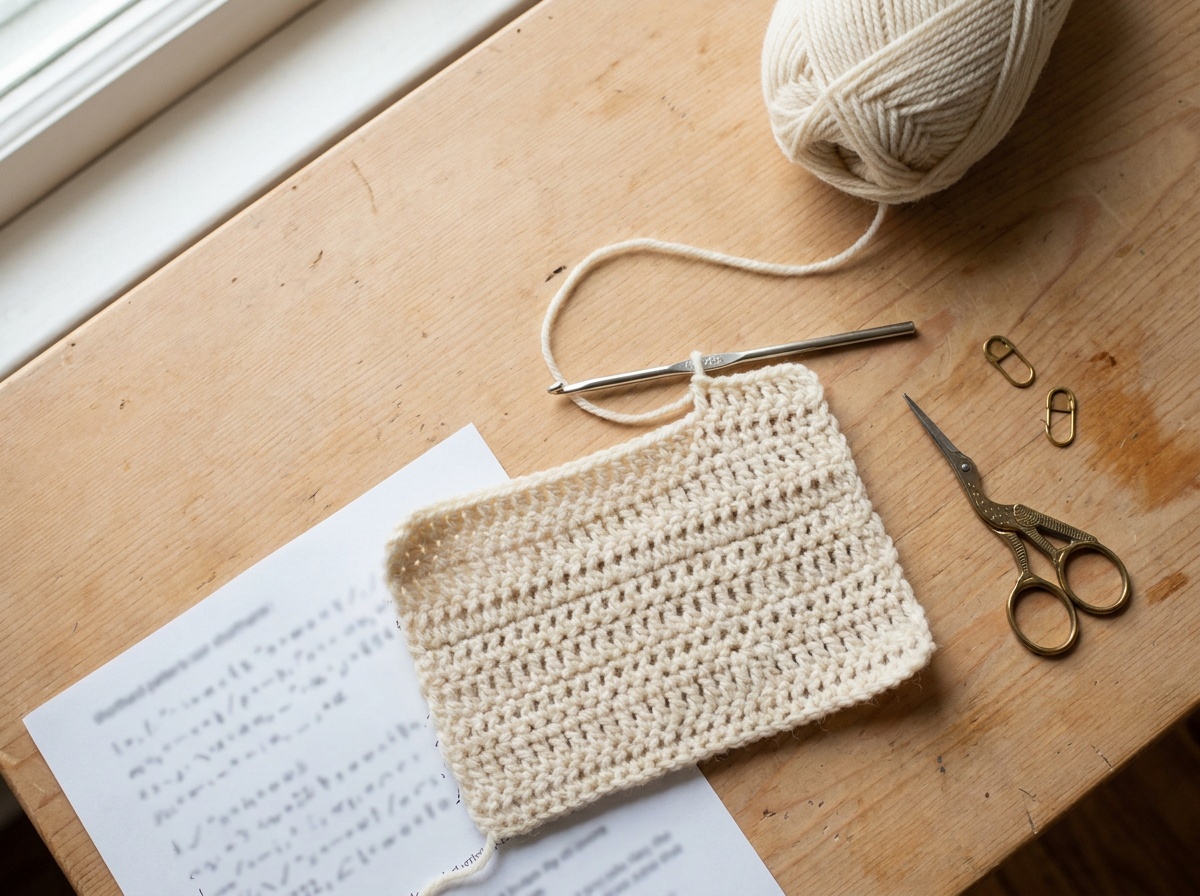
A crochet pattern is written in abbreviations (sc, dc, ch), grouped with asterisks, parentheses, and brackets that mark repeats, and checked with a stitch count at the end of each row or round. The two things that trip up most makers: US and UK terms use the same words for different stitches, and turning chains count as a stitch in some patterns but not others. Once you can read those two things, the rest is vocabulary.
A crochet pattern looks like a wall of shorthand the first time you open one. It isn't. Every abbreviation traces back to a small, fixed list, and every asterisk or bracket is doing one of a handful of jobs: marking a repeat, grouping a stitch cluster, or telling you how many stitches you should have when you're done. Learn the shorthand once and every pattern from every designer reads the same way.
What the abbreviations mean
| ch | chain stitch |
| sl st | slip stitch |
| sc | single crochet |
| hdc | half double crochet |
| dc | double crochet |
| tr | treble (triple) crochet |
| yo | yarn over |
| st(s) | stitch(es) |
| rep | repeat |
| rnd(s) | round(s) |
| sk | skip |
| inc / dec | increase / decrease |
| BL / FL | back loop / front loop |
| tog | together (as in sc2tog, a decrease) |
| rem | remaining |
| RS / WS | right side / wrong side |
These abbreviations are standardized by the Craft Yarn Council, the industry body most US pattern designers and yarn companies follow, so they read the same across a magazine pattern, an indie PDF, and a yarn label insert. A pattern never tells you to make the starting slip knot. That step is assumed before row 1 begins.
What the symbols and punctuation mean
| * (single asterisk) | Repeat everything after it as directed later in the instruction |
| * ... * (two asterisks) | Repeat everything between them as many times as stated |
| ( ) parentheses | Work the enclosed stitches into a single stitch or space, or repeat as directed |
| [ ] or { } brackets | Work the enclosed instructions the number of times stated right after the bracket |
| Number at end of row/round | A stitch count, not an instruction: it tells you what you should have after that row |
The instruction that confuses nearly every new crocheter is "skip the 2nd chain from hook." Count from the hook, not from the tail end of your starting chain, and count the loop already on your hook as chain 1.
A stitch count at the end of a row (often written as "(14 sc)") is there so you can catch a mistake immediately. If your count is off, the error is almost always in the row you just finished, not somewhere further back.
Why US and UK terms use the same words differently
This is the single most common trap in crochet patterns, and the fix is one idea, not a table to memorize. Every US stitch name sits one step "behind" its UK equivalent: what Americans call single crochet, British patterns call double crochet. What Americans call double crochet, British patterns call treble. The name shifts down a rung, all the way through the list.
| US single crochet (sc) | UK double crochet (dc) |
| US half double crochet (hdc) | UK half treble (htr) |
| US double crochet (dc) | UK treble (tr) |
| US treble crochet (tr) | UK double treble (dtr) |
| US double treble (dtr) | UK triple treble (trtr) |
| US gauge | UK tension |
| US skip | UK miss |
A pattern's country of origin doesn't reliably tell you which set of terms it uses, especially with self-published and international designers. Check the pattern's abbreviation key before you start a single stitch. If a pattern calls for "dc" and the finished measurements look too small for what double crochet should produce, you're probably holding a UK pattern.
How turning chains count (and when they don't)
- In single crochet, the turning chain (ch 1) does not count as a stitch. Work your first stitch into the same first stitch, not into the chain.
- In double crochet and taller stitches, the turning chain (ch 3 for dc) does count as the first stitch of the row. You skip the first stitch of the row and work your next stitch into the second one.
- Half double crochet varies by designer. Some patterns count the ch-2 as a stitch, some don't. A well-written pattern states this explicitly. If yours doesn't, check your stitch count after the first row against the row before it.
How to measure and match gauge
Gauge is stitches and rows per 4 inches (10 cm), never per inch. It's the number that decides whether your finished piece comes out the size the pattern promises.
To check gauge: work a swatch a few stitches larger than 4x4 inches in the pattern's stitch and hook. Wash and block it the way you'll treat the finished piece, lay it flat, and measure a clean 4-inch span in the middle, away from the edges. Count stitches, then count rows.
- More stitches per 4 inches than the pattern states means your work is tighter than the designer's. Go up a hook size.
- Fewer stitches means your work is looser. Go down a hook size.
Gauge matters most on anything fitted, garments, hats, anything worn close to the body. It matters far less on a blanket or scarf where an inch either way won't ruin the fit. Row gauge matters less than stitch gauge for most projects, since you can add or remove rows to fix length, except when a pattern is worked side to side or ties shaping to an exact row count.
Reading hook sizes and yarn weights
Hook letters and numbers vary slightly between manufacturers. The metric size in millimeters is the reliable figure, so check that first if a hook seems off from what a pattern expects.
| 2.25 mm | B-1 |
| 3.5 mm | E-4 |
| 4 mm | G-6 |
| 5 mm | H-8 |
| 5.5 mm | I-9 |
| 6 mm | J-10 |
| 6.5 mm | K-10½ |
| 9 mm | M/N-13 |
Yarn weight and hook size are linked: a pattern written for worsted weight (a #4 medium yarn) expects roughly an I-9 to K-10.5 hook, while a fine sock-weight yarn expects something much smaller. The pattern's stated gauge always overrides a general weight-to-hook chart, so match the gauge first and treat weight charts as a starting point.
Reading charts instead of written instructions
Crochet charts use a standard symbol for each stitch: a small vertical line for a chain, a dot for a slip stitch, a cross for single crochet, and progressively taller marks for half double, double, and treble crochet. Charts are read right to left on right-side rows and left to right on wrong-side rows, matching the direction you worked the fabric. That switch is where most beginners moving from written patterns to charts get turned around, so check which side of the work a row represents before you start reading it.
Skill levels, if a pattern states one
| Basic (Beginner) | Basic stitches, may include simple increases and decreases |
| Easy | Simple stitch patterns, color work, and/or shaping |
| Intermediate | Involved stitch patterns, color work, and/or shaping |
| Complex (Experienced) | Complex stitch patterns, multiple techniques combined |
What's the difference between a slip stitch and a single crochet?
A slip stitch pulls the yarn through both the stitch and the loop on your hook in one motion, with no yarn-over in between. It's used to join rounds or move across stitches without adding height. Single crochet adds a yarn-over step and builds actual height in the fabric.
Why does my stitch count come out wrong partway through a pattern?
Check the row directly above the mismatch first. Miscounts almost always happen in the stitches you worked most recently, often from missing the last stitch of a row or working into the turning chain when the pattern says not to.
Do I need to know how to read charts if I can read written instructions?
No. Written instructions and charts describe the same pattern. Charts are useful for visualizing repeats and lace or colorwork placement, but any pattern with full written instructions doesn't require chart-reading to complete.
Is gauge as important for a blanket as it is for a sweater?
No. Gauge matters most for fitted, wearable pieces where size has to be exact. A blanket or scarf a little larger or smaller than stated rarely affects whether the finished piece works.