How to Identify Fabric with a Burn Test
A burn test tells you what a mystery fabric is made of by watching how a small swatch reacts to flame, smoke, and ash.
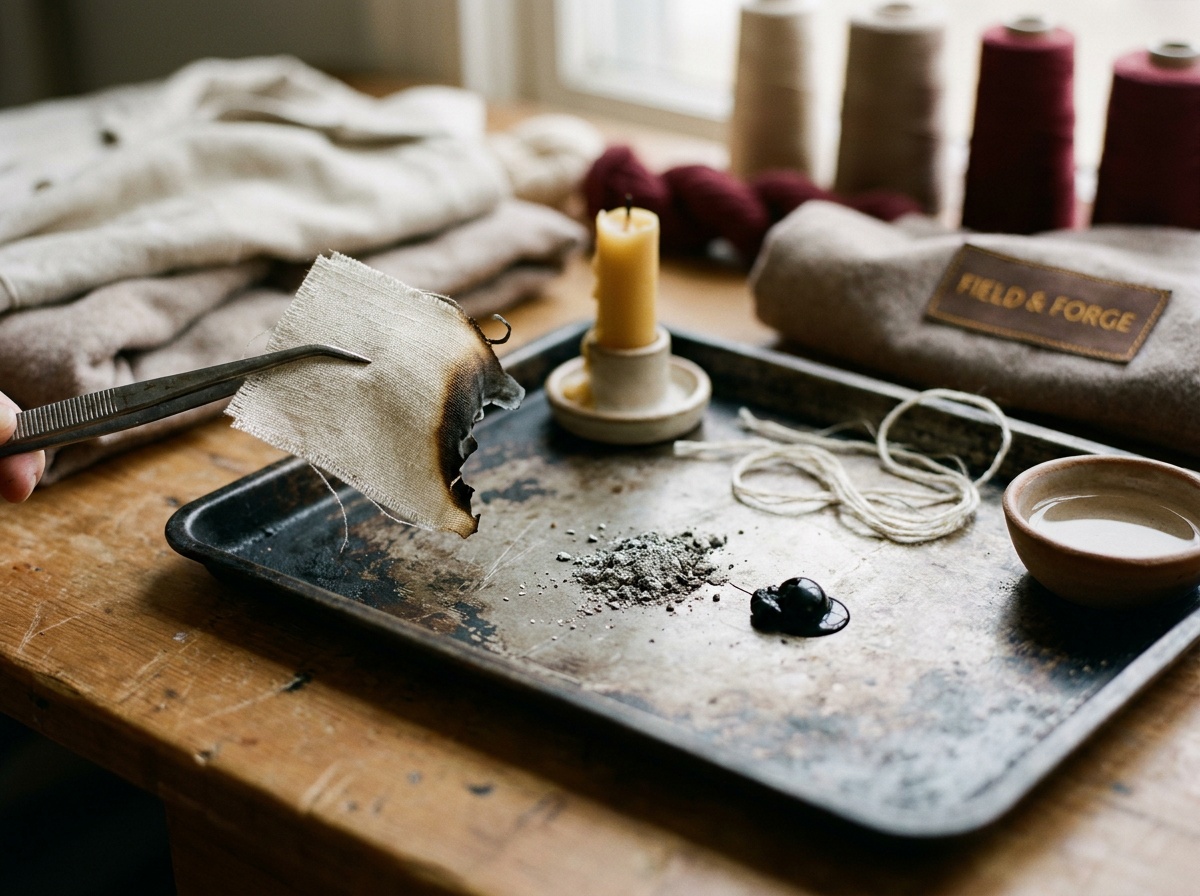
Burn a small swatch and watch five things: how it reacts near the flame, how it burns in the flame, what it does once you pull it away, what the smoke smells like, and what's left behind. Natural fibers like cotton, linen, wool, and silk burn or self-extinguish and leave soft ash. Synthetics like polyester, nylon, acrylic, and spandex melt first and leave a hard bead. That split, ash versus bead, is the fastest way to sort a mystery fabric into a family.
A label falls off, a scrap turns up in the stash with no memory attached, or a secondhand find has no content tag at all. A burn test won't give you an exact percentage, but it will tell you the fiber family in under a minute, using nothing but a swatch, a flame, and your nose.
What you need before you start
You don't need a lab. You need a small piece of fabric, a heat source, and somewhere safe to do it.
- A swatch about 2 inches square, or a few inches of yarn or thread pulled from a seam allowance or hem
- Tweezers or tongs to hold the swatch, so you're not holding it with your fingers
- A heat-safe dish or metal tray to burn over
- A lighter, candle, or match
- A window open or a fan running for ventilation
- A cup of water within reach
Burn tests involve an open flame and produce smoke. Work over a metal tray or sink, never a cutting mat or countertop you care about. Hold the swatch with tweezers, not your fingers. Keep water nearby to drown the ember, and do this away from curtains, paper, and anything else that catches. Not a job for kids to run alone.
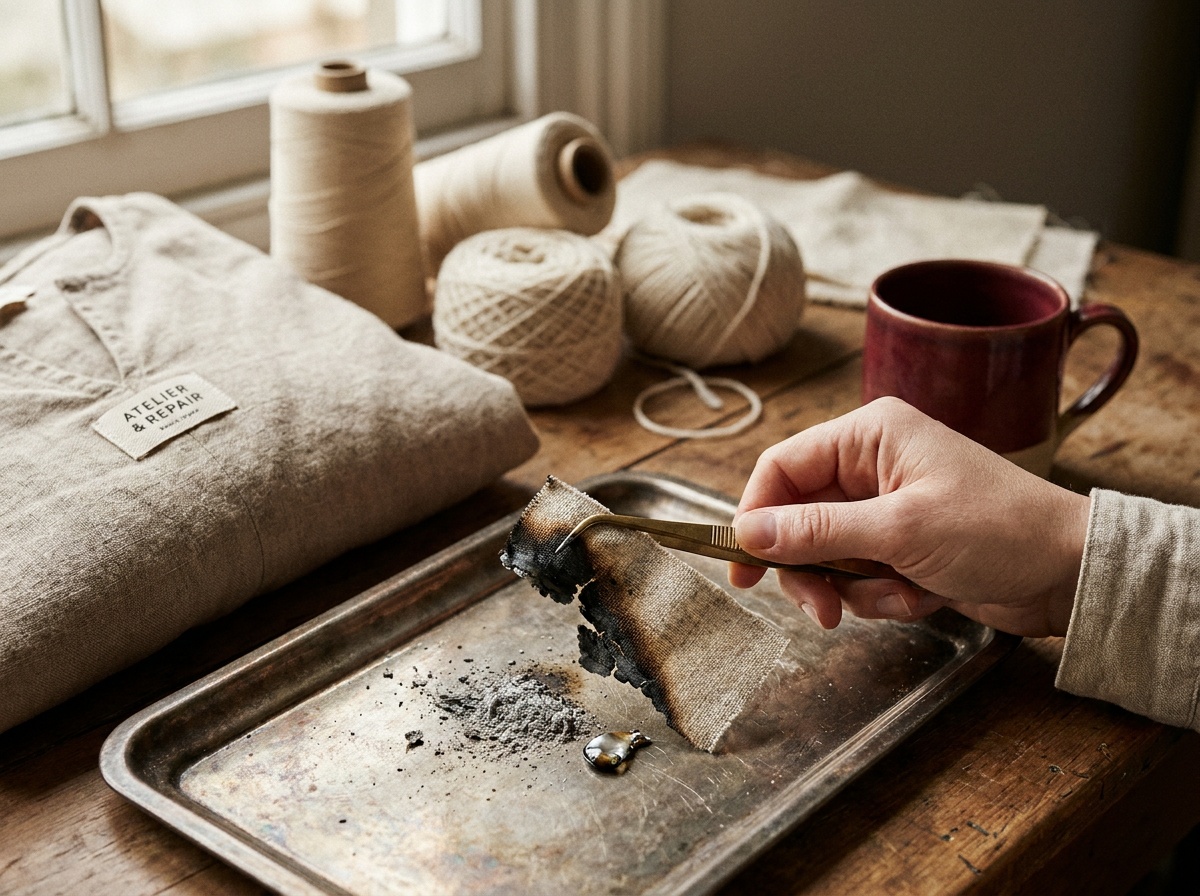
How to run the test, step by step
Do the same five checks every time, in the same order, so you're comparing like for like.
- Near the flame. Hold the swatch close but not touching. Does it shrink or curl away from the heat, or does it ignite readily?
- In the flame. Touch it to the flame. Does it catch fast and burn brightly, or melt first?
- Away from the flame. Pull it back. Does it keep burning or glowing on its own, or does it go out?
- The smell. Waft the smoke toward you, don't lean into it. Paper, hair, chemical, vinegar: the smell narrows the fiber fast.
- The residue. Once it's out and cool, look at what's left. Soft ash that crumbles, or a hard bead that won't crush?
What each fiber does
| Cotton / linen / hemp / ramie | Ignites readily and burns steadily, doesn't self-extinguish. Smells like burning paper (linen leans toward burning hay). Leaves a fine, soft gray ash. |
| Rayon / viscose / Tencel / modal | Ignites fast, keeps burning after the flame is gone. Smells like burning paper, close to cotton. Leaves a light gray ash, sometimes a wispy tail. |
| Wool | Curls away from the flame, burns slowly and sizzles, usually self-extinguishes. Smells like burning hair. Leaves a dark, brittle ash that crushes to powder. |
| Silk | Curls away from the flame, burns slowly, self-extinguishes. Smells like burning hair or feathers. Leaves a small dark bead that crushes to powder. |
| Polyester | Shrinks from the heat, then melts and burns, often keeps burning or melting after removal. Smells sweet and chemical. Leaves a hard, shiny black bead. |
| Nylon | Shrinks and melts before it burns, usually self-extinguishes. Smells distinctly like burnt celery. Leaves a hard, cream-to-tan bead. |
| Acetate | Burns and melts at the same time, can flare after the flame is gone. Smells like vinegar. Leaves a hard, dark bead with no true ash. |
| Acrylic | Shrinks fast, then burns hot with black smoke, keeps burning. Smells sharp and acrid. Leaves a hard, irregular black or brown bead. |
| Spandex / elastane | Melts and keeps burning. Smells chemical, somewhat rubbery. Leaves a soft, gummy residue, not a hard bead, which sets it apart from nylon or polyester. |
| Blends | Show a mixed signature, for example a paper smell alongside a hard bead. Tells you which fiber families are present, not exact percentages. |
Reading the two fastest clues
Before you try to memorize every smell, two questions get you most of the way there.
Does it keep burning once you pull it from the flame, or does it go out? Wool and silk self-extinguish most of the time. Cotton, linen, and rayon keep burning or glowing. Synthetics are inconsistent here, some continue burning or melting, so this clue is strongest for telling protein fibers (wool, silk) apart from plant fibers (cotton, linen, rayon).
Is the residue soft ash or a hard bead? Ash that crumbles between your fingers means a natural or regenerated cellulose fiber: cotton, linen, rayon. A hard bead that won't crush means a synthetic: polyester, nylon, acetate, or acrylic. Spandex is the exception, its residue is soft and gummy rather than a clean bead, which is the tell that separates it from the other synthetics.
What to do about blends
A burn test tells you what fiber families are present, not what percentage of each. A poly-cotton blend might show quick ignition from the cotton alongside a hard bead in the ash from the polyester. A viscose-silk blend can carry both a paper smell and a hair smell off the same swatch. Whichever behavior is strongest, mostly ash and self-extinguishing versus mostly bead and sustained burning, points to the majority fiber, but that's a rule of thumb, not a measurement.
For anything that needs an exact number, resale listings, allergy concerns, or compliance labeling, that's a job for a lab. The industry standard, ASTM D276, combines burn testing with chemical solubility and microscopic examination specifically because burn behavior alone only identifies the generic fiber class.
Is a burn test dangerous?
It's a small open flame on a small swatch, so treat it like lighting a candle: work over a heat-safe surface, use tweezers instead of your fingers, keep the area ventilated, and have water within reach.
Can a burn test tell me the exact percentage of a blend?
No. It tells you which fiber families are present. For an exact blend ratio you need lab testing such as ASTM D276, which pairs burn behavior with chemical and microscopic analysis.
What if I can't tell cotton from linen?
Both burn readily, don't self-extinguish, and leave soft gray ash. Linen's ash tends to be paler and the afterglow lasts slightly longer, but the two are close enough that a burn test alone may not separate them. Fiber feel and weave often help more than the burn does here.
Does a burn test work on finished garments with flame-retardant treatment?
Treated fabric burns differently than the raw fiber would, so results can be misleading. If you know a garment has been flame-retardant treated, don't rely on a burn test to identify the base fiber.
What's the fastest way to tell natural from synthetic without memorizing every smell?
Check the residue. Soft ash that crumbles points to a natural or regenerated cellulose fiber. A hard bead that won't crush points to a synthetic, except spandex, which leaves a soft, gummy residue instead of a bead.