How to Build a Size Chart From Scratch
The three documents a size range needs, how grade rules connect them, and where the numbers come from.
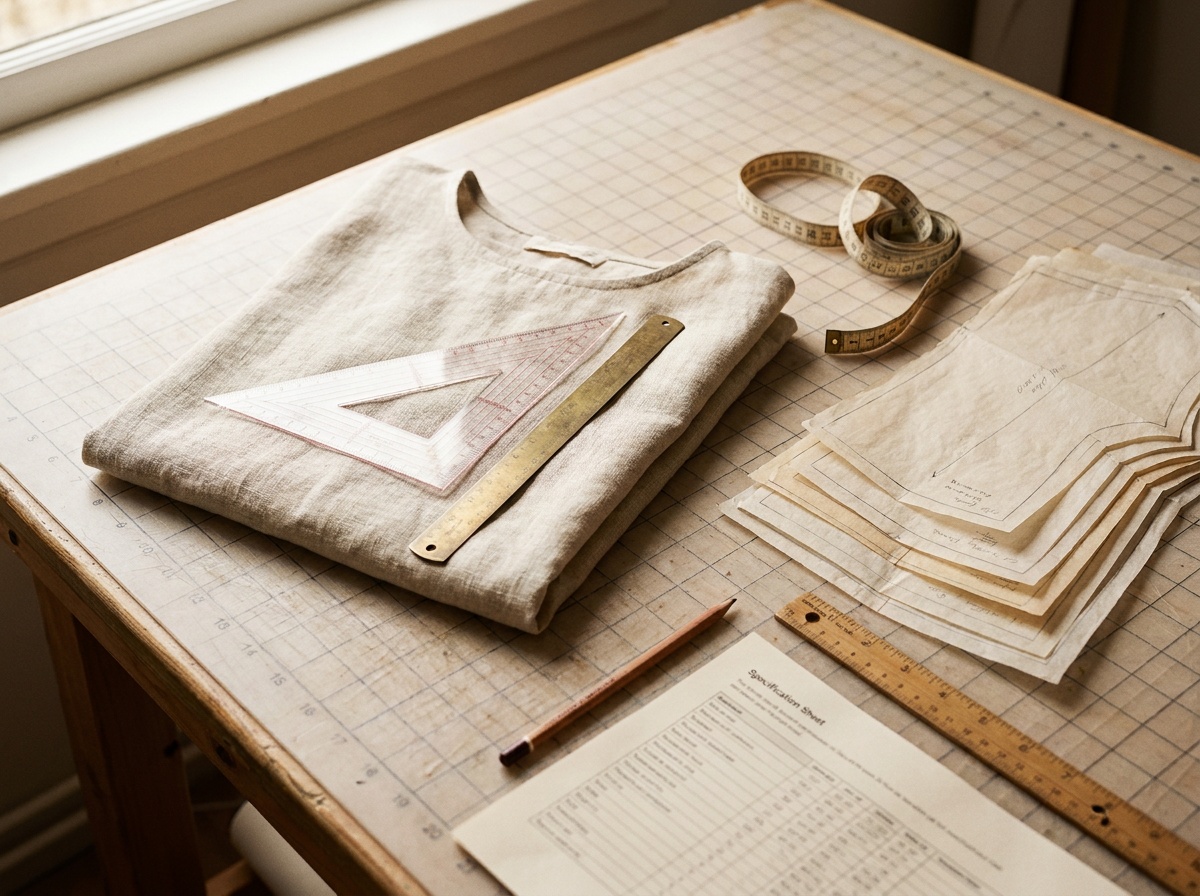
A size chart alone doesn't get a garment produced. Production needs three connected documents: a size chart (body measurements per size label), a graded spec (garment measurements at every point of measure, for every size, inside the tech pack), and a grade rule (the fixed increment applied at each point of measure between adjacent sizes). The grade rule is built once, on a base size in the middle of the range, then applied outward to generate every other size mathematically. Get the base size and the grade rule right and the rest of the range follows; get either wrong and every size built from it is wrong the same way.
Most first-time brand owners treat "size chart" as one document. It's the customer-facing piece, and it's the smallest part of the job. What goes to a factory is a graded spec: garment measurements, not body measurements, at every point of measure, for every size, with tolerances stated. The size chart and the graded spec are related by a grade rule, and building that grade rule correctly is the work.
Size chart, spec sheet, and grade rule are three different documents
Size chart. The customer-facing or brand reference. Shows body measurements (bust, waist, hip, height) against size labels (XS–XL, 0–20, and so on). This is what a shopper checks before buying.
Graded spec. The factory-facing document inside the tech pack. Shows garment measurements, not body measurements, at every point of measure, for every size, with tolerances. This is what a pattern maker builds from.
Grade rule. The increment applied at each point of measure between adjacent sizes. It's the math that connects the base size's spec to every other size's spec.
| Base size | Middle of the size range, or the brand's best-selling size |
| Fit model | Body proportions matched to the target customer, not a size label alone |
| Points of measure (POMs) | 15 to 25 for most garment categories |
| Body measurement | Input data: bust, waist, hip, height, taken on the body |
| Garment measurement | Output data: body measurement plus ease, taken flat on the garment |
| Grade rule | The increment applied at each point of measure between adjacent sizes |
| Tolerance | Acceptable variance per point of measure, stated in the graded spec, not assumed |
A size chart without a grade rule and a graded spec is a customer-facing document with nothing behind it. Founders who stop at the size chart find out at first sample that "medium" doesn't mean anything specific to the factory yet.
Body measurement vs. garment measurement
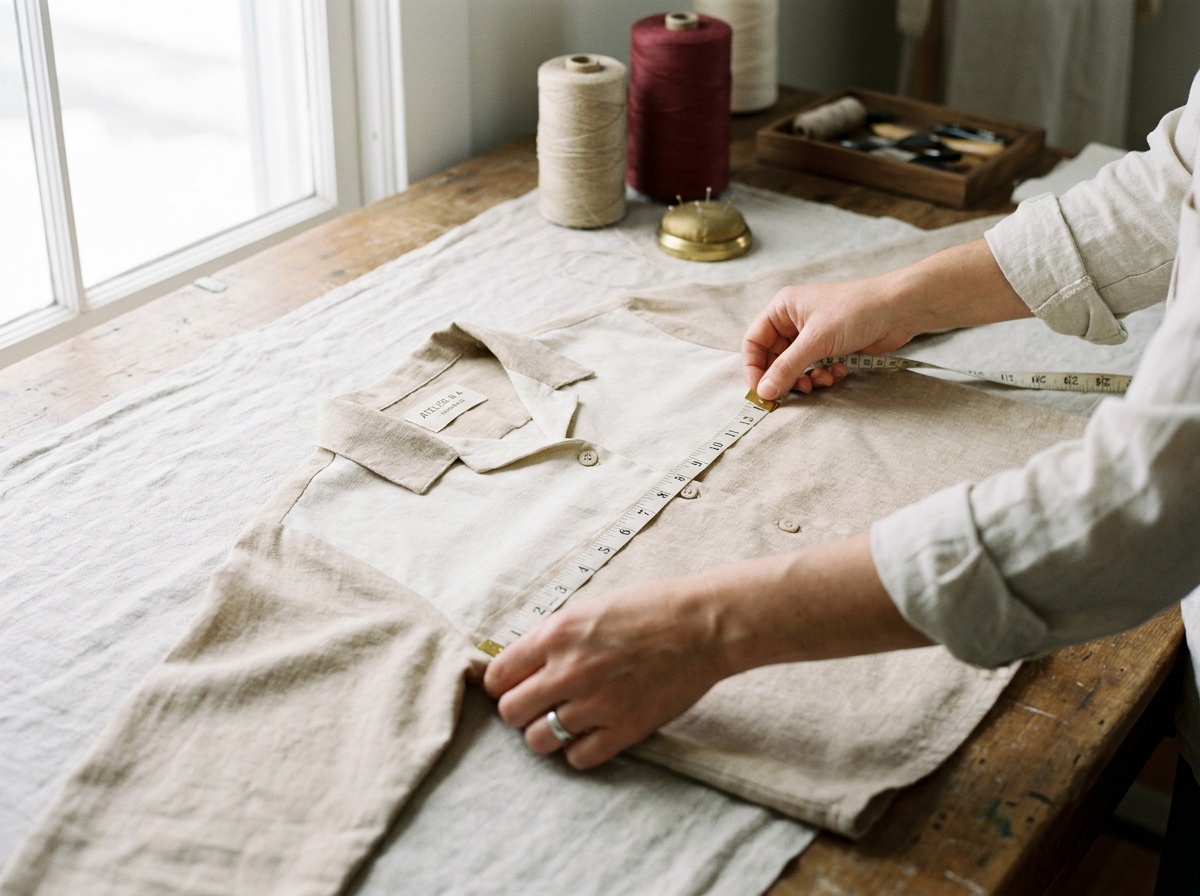
These get used interchangeably and shouldn't be. A body measurement is taken on a person or a fit model: the actual circumference of a chest, waist, or hip. A garment measurement is taken flat on the finished piece of clothing, and it's larger than the body measurement by an amount called ease, added so the garment can be worn and moved in.
The size chart usually shows body measurements. The graded spec inside the tech pack shows garment measurements. A factory needs the second one. If a brand hands a factory only body measurements and no ease allowance, the factory either guesses at ease or builds a garment that measures exactly what the body measures, which fits nothing.
Choosing a fit model
A fit model represents the brand's target customer's proportions, not their size label alone. Two people can both wear a size M with different bust-waist-hip ratios, and the fit model should match the brand's intended proportion, not an average across all size-M bodies.
Typical commercial fit-model ranges, as an industry convention rather than a fixed rule:
| Women's | 5'5"–5'9", bust-waist-hip near 34-26-37 in |
| Men's | Around 6'0", chest-waist-hip near 40-32-39 in |
Plus-size, petite, and streetwear-oriented brands intentionally use fit models matched to their own customer instead of these ranges. That's the correct call for those brands, not a deviation from one. Track the fit model's measurements at every key point (bust, waist, hip, shoulder, inseam) and recheck periodically. Fit models change, and so do the bodies a brand is designing for.
An early-stage brand without budget for a professional fit model has a few workable alternates: use a well-fitted existing garment as a physical reference, hire a freelance fit model or technical designer for fit sessions only, or use a fit form or dress form set to the base size's measurements, backed by a live fit check before locking anything.
Choosing a base size
The base size (also called the sample size) is the one size the pattern is drafted and perfected on before any grading happens. Every other size in the range is derived from it mathematically, through the grade rule. Get the base size wrong, and every size graded from it carries the same error outward.
Convention places the base size in the middle of the intended size range: if a brand runs XS–XL, base is usually M; if it runs 0–20, base is often 8 or 10. Centering the base size this way minimizes the total grading distance to either extreme, which keeps grading error and proportion distortion smaller at the edges of the range.
The base size should reflect the brand's best-selling or most representative customer, not the numeric middle of the range alone. Some brands deliberately set the base size at their highest-volume size even if that shifts it off-center. Either way, the discipline is the same: perfect the fit on the base size through fit sessions, then grade outward. Don't try to perfect multiple sizes at once.
Points of measure
A point of measure (POM) is a precisely defined location on the garment, not the body, where a measurement is taken flat: "chest, 1 inch below armhole," or "hem width, laid flat." The human body has 60-plus measurable points, but a working spec for one garment style typically uses 15 to 25 POMs, depending on complexity. A basic tee needs far fewer than a tailored jacket.
| Tops | Chest/bust, waist, hem width, body length, shoulder width, sleeve length, bicep, armhole depth, neck width, front and back neck drop |
| Bottoms | Waist, hip, front rise, back rise, inseam, outseam, thigh width, knee width, leg opening |
Different garment categories don't share a POM template. A knit tee and a structured jacket are measured at different points because they're built differently.
POMs are measured flat, and industry convention often states them as a half-measurement. "Chest 20 inches" on a spec usually means the garment laid flat, pit-to-pit, which is half the total circumference; double it for the full circumference the wearer's body passes through. This half-versus-full distinction is one of the most common sources of confusion in size charts pulled from different sources, and it's worth checking explicitly any time you compare a POM value against another chart.
Grade rules and grade increments
A grade rule is the increment applied at a point of measure between adjacent sizes: S to M, M to L, and so on. Multiple sources, including Studio Faro's pattern-grading breakdowns and cross-industry grading references, converge on similar standard increments. Exact values still vary by brand, garment category, and region, so treat the table below as a typical starting point, not a fixed rule.
| Chest / bust | 1 in / 2.5 cm |
| Waist | 1 in / 2.5 cm |
| Hip | 1 in / 2.5 cm |
| Shoulder width | 0.25 to 0.5 in / 0.6 to 1.2 cm |
| Body length | 0.25 to 1 in / 0.6 to 2.5 cm, commonly 0.5 in |
| Sleeve length | 0.25 to 0.5 in / 0.6 to 1.2 cm |
| Neck width | 0.25 in / 0.6 cm |
| Bicep / armhole depth | 0.25 to 0.5 in / 0.6 to 1.2 cm |
| Front / back rise | 0.25 to 0.5 in / 0.6 to 1.2 cm |
| Thigh width | 0.5 to 1 in / 1.2 to 2.5 cm |
| Leg opening | 0.25 to 0.5 in / 0.6 to 1.2 cm |
| Inseam (pants) | Often ungraded; offered as short/regular/tall instead of graded by size |
The half-versus-full grading confusion
This is the single biggest source of contradictory-looking numbers across public sources. A "2-inch grade" was, historically, the common worldwide standard for a full-circumference jump between sizes at chest or bust. Many current brands instead state a 1-inch grade using the flat, half-body measurement convention described above. Depending on which convention a source uses, the same real change in size can be reported as "1 inch" or "2 inches," and the two aren't in conflict, they're describing the same distance in different units. Before comparing a grade value from two different sources, confirm whether each is stating a half (flat) or full (circumference) measurement.
Plus-size grading widens
Grade increments typically get larger above a brand's core range, commonly increasing from around 1 inch to 1.5–2 inches per size once past roughly size 16–18 or XL. The body doesn't scale linearly, and curves increase disproportionately at larger sizes. This isn't a uniform flat jump applied everywhere: shoulder length tends to stop increasing in plus sizes even as bicep and back width keep increasing, a shift in proportion rather than a uniform scale-up.
Grading is style-specific, not universal
A slim-fit shirt and a relaxed-fit shirt from the same brand may use different grade rules at the same point of measure, because the grade has to preserve the intended silhouette at every size, not add a flat number across the board.
Ease allowances
Ease is the difference between a body measurement and the finished garment measurement, added so the garment can be worn and moved in. Two distinct components sit inside that word:
Wearing ease is the minimum room needed for movement and comfort. Design ease is additional room added on top, deliberately, for a loose or oversized silhouette.
A commonly cited practical minimum for a basic fitted woven top: roughly 2 inches at bust/chest, 1 inch at waist, 1.5 inches at hip.
| Close-fitting | Up to 2.5 in / 6.5 cm total ease |
| Fitted | 3 to 4 in / 7.5 to 10 cm |
| Semi-fitted | 4 to 5 in / 10 to 12.5 cm |
| Loose-fitting | 5 to 8 in / 12.5 to 20 cm |
| Very loose / oversized | Over 8 in / 20+ cm |
Knit fabrics carry much less wearing ease than wovens, because the fabric itself stretches. Some knit garments use negative ease, where the finished garment measurement is smaller than the body measurement and the fit relies on the fabric's stretch and recovery. This is common in activewear, base layers, and fitted knit tees.
Ease gets decided and locked at the base-size fit stage, then held consistent across the graded size run. The grade rule moves the garment measurement at each size; it doesn't touch the ease amount itself.
Tolerances
Standard tolerance on a point-of-measure grid is commonly stated around ±0.25 inch (±0.6 cm) for most garment POMs, tighter for critical fit points and looser where the dimension isn't fit-critical (hem width, decorative elements, for instance).
State tolerance explicitly per POM in the graded spec. A factory working from a spec with no stated tolerance will apply its own default, and that default may not match what the brand expects.
Reference standards: what ASTM covers
ASTM International publishes standardized body-measurement tables used across the US apparel industry as a benchmarking reference, not a mandatory requirement. ASTM D5585 covers the adult female Misses figure type, sizes 00–20. ASTM D6192 covers girls, sizes 2–20 (regular and slim) and girls plus. ASTM publishes a further family of tables by demographic, including men's, juniors', and women's plus.
The actual numeric measurement tables inside these standards are sold through ASTM's store, not freely public, so this guide describes what the standards are and how brands use them rather than reproducing specific table values. Brands without the budget to run their own measurement study commonly use an ASTM table, or a competitor's public size chart, as a starting reference point rather than measuring a population from scratch.
One technical-design source estimates that building a complete size chart from an original body-measurement study, rather than adopting a reference standard, runs around $5,000 and roughly 30 days for a startup brand. Treat that as one source's estimate, not a fixed industry figure. It's the practical reason many early brands start from a reference standard or competitor benchmarking instead of commissioning their own study.
Worked example: women's woven top, chest point of measure
Illustrative example built from converging grade conventions across sources, not an exact quote from a single named source. Base size M, chest measured flat, pit-to-pit.
| XS | 18 in |
| S | 19 in |
| M (base) | 20 in |
| L | 21 in |
| XL | 22 in |
| 2XL | 23.5 in, plus-size grade widens to 1.5 in |
The grade holds at exactly 1 inch per step through the core range, then widens at 2XL, consistent with the plus-size grading behavior described above.
The workflow, start to finish
- Define the target customer and the size range you'll launch with.
- Select a base size in the middle of that range, or your best-selling size.
- Select or confirm a fit model whose proportions match your target customer.
- Decide the POMs for the garment category, typically 15 to 25, depending on style complexity.
- Take body measurements (fit model, or a reference standard or competitor data if no fit model exists yet) and add ease to get garment measurements at the base size.
- Fit-test the base size on the fit model or form, and adjust until approved.
- Apply the grade rule at each POM to generate the full graded spec across all sizes.
- Sample at least three points across the range, the base plus one small and one large size, to confirm the grade holds proportion at the extremes, not only at the base.
- Lock the graded spec with tolerances into the tech pack for factory submission.
Work with a technical designer.
Setting a base size and a grade rule that hold proportion across a full range is where a size chart most often goes wrong, and it's hard to catch from inside your own spreadsheet. A technical designer who grades ranges for a living can check it before it goes to a factory.
Is a size chart the same thing as a tech pack's spec sheet?
No. A size chart shows body measurements per size label, for customers. The spec sheet inside a tech pack shows garment measurements at every point of measure, for every size, with tolerances, for the factory. A brand needs both, connected by a grade rule.
Why does the base size matter more than any other size in the range?
Every other size is derived mathematically from the base size through the grade rule. An error in the base size's fit or measurements carries into every size graded from it, in the same direction and roughly the same proportion.
Is a 1-inch grade different from a 2-inch grade at the chest?
Not necessarily. A 1-inch grade usually refers to a flat, half-body measurement, while a 2-inch grade often refers to the full circumference. The two can describe the same real difference in size stated in different conventions, so check which one a given source means before comparing numbers.
Do I need a professional fit model to start?
No. Early-stage alternates include a well-fitted reference garment, a freelance fit model or technical designer hired for individual fit sessions, or a dress form set to the base size's measurements backed by a live fit check.
Can I use an ASTM table instead of measuring my own fit model?
Many brands do, especially early on, since ASTM tables offer a standardized benchmarking reference. The tables themselves are sold through ASTM and aren't freely public. They're a reasonable starting point, but a brand with a distinct target customer, plus-size, petite, or otherwise, usually still needs its own fit model to match its actual proportions rather than a generic reference.
Reviewed by Karolyn, Technical Apparel Designer · kellyhouse.studio