CMT vs FOB vs Full-Package Production
What CMT, full-package, and FOB describe, why they aren't three versions of the same thing, and how to tell which production model and pricing term you're being quoted.
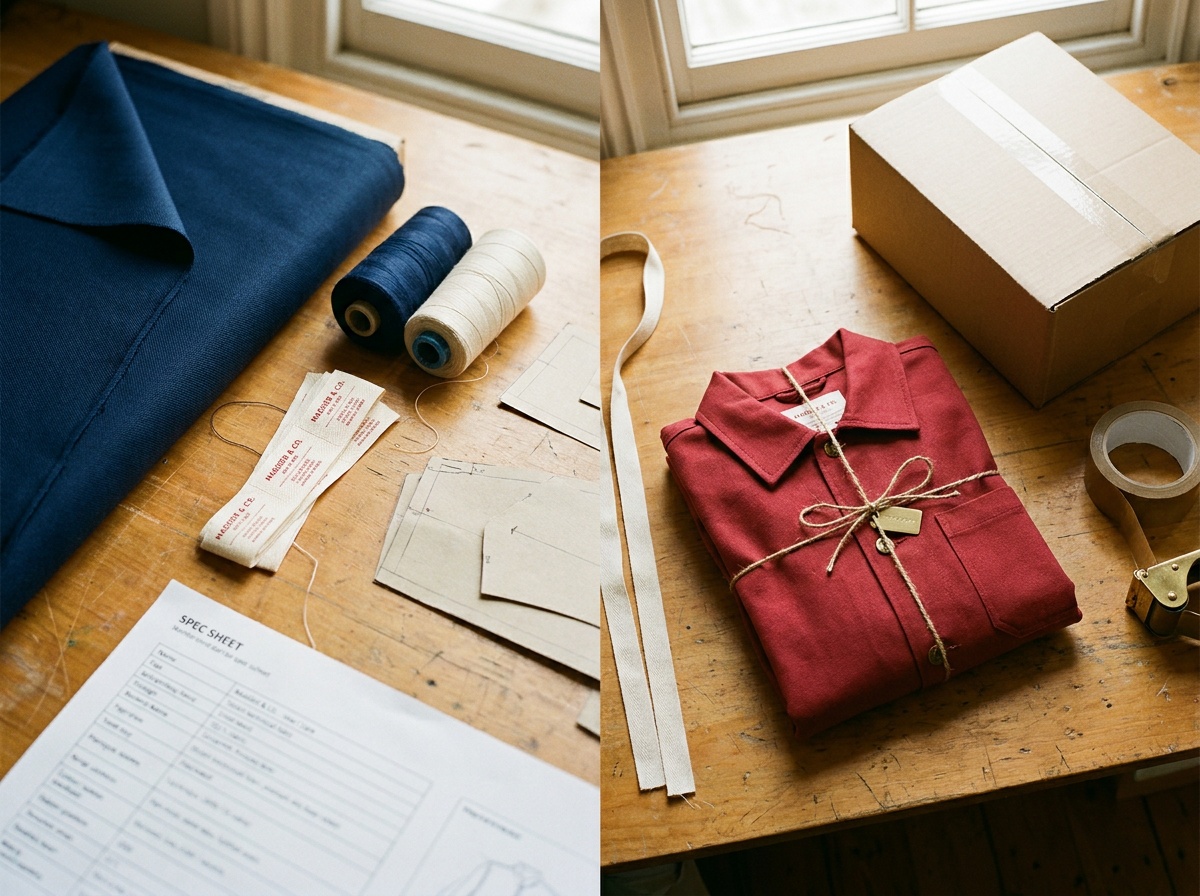
CMT and full-package are production models: they describe who sources materials, makes patterns, and runs the line. FOB is a pricing term (an Incoterm): it describes the point where the supplier's cost and risk end, which is when goods are loaded at the origin port. A factory quoting "FOB" can be running either a CMT or a full-package operation underneath. The two ideas answer different questions, and treating them as one three-way choice is the most common confusion in early sourcing conversations.
Founders sourcing a first production run usually meet these three terms in the same breath, often from the same supplier email, and assume they're three options on one menu. They aren't. CMT and full-package describe who does the work. FOB describes who pays for what, and at what point in shipping. A factory can be CMT and quote FOB pricing. A factory can be full-package and quote FOB pricing. The terms sit on different axes.
This guide untangles the two axes, then gives the reference numbers, so you know which question you're asking a supplier.
Why these three terms get lumped together
Trade shorthand is part of the problem. Some suppliers and trading companies use "FOB" loosely to mean "the factory sources the materials and sells me a finished, ready-to-ship garment," contrasted against "CM" or "CMT," where the buyer supplies materials. That usage is common and you'll see it in supplier decks and forums. It isn't wrong to encounter, but it isn't the technical definition either. Strictly, FOB is an Incoterm, one of several standard shipping terms that fix the point where cost and risk transfer from seller to buyer. It says nothing on its own about whether the factory made the patterns or sourced the fabric.
A CMT workshop can quote you a price "FOB Shanghai." A full-package factory can quote you a price "FOB Ho Chi Minh City." Same Incoterm, two different production models underneath. When a supplier says "we do FOB," ask a follow-up: does that mean they source materials (functionally full-package), or does it describe where their price stops in the shipping chain? Both uses show up in real supplier communication. The only way to know which one you're getting is to ask what's included.
CMT: Cut, Make, Trim
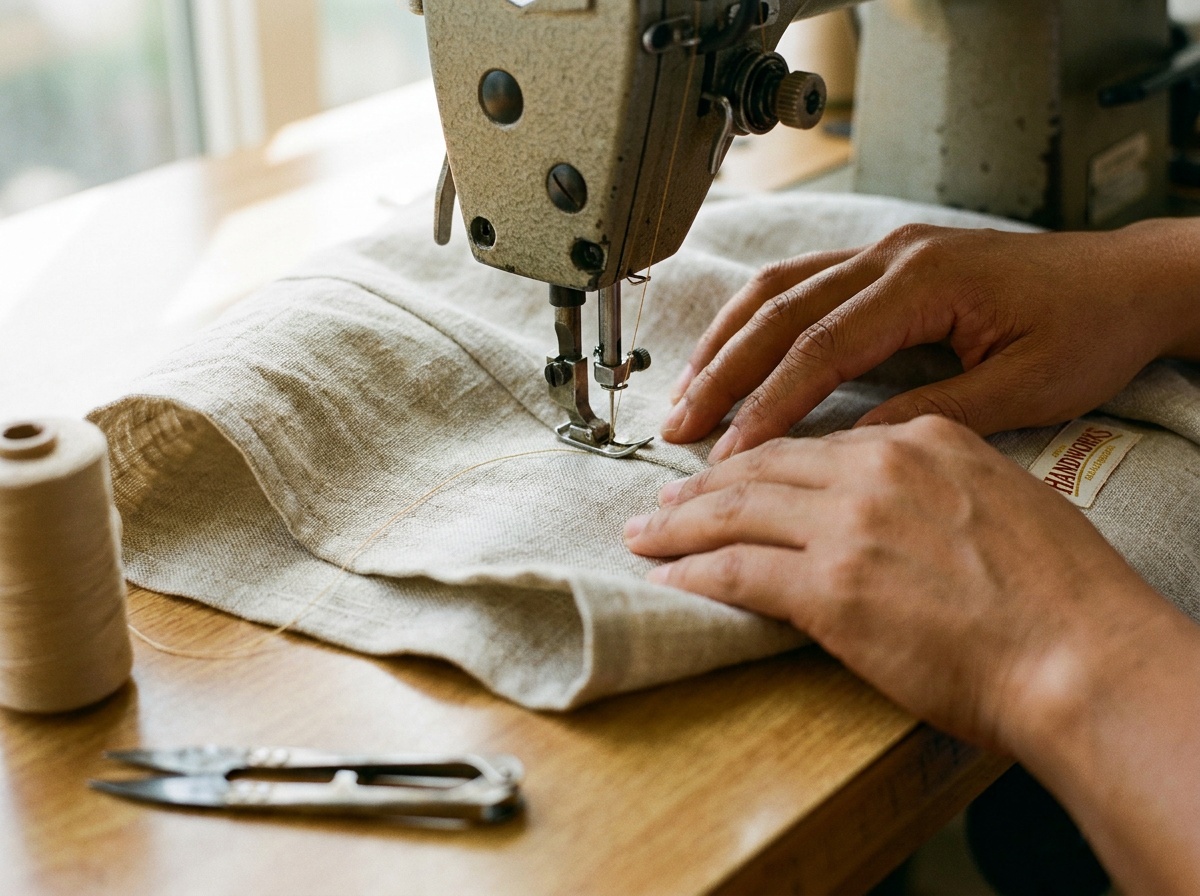
Under CMT, the brand supplies the fabric, trims, a complete tech pack, and construction guidance. The factory does three things: cut the fabric to pattern, make (sew and assemble) the garment, and trim it (finish threads, quality check, fold and pack). Some sources use "CM" (Cut and Make) as a near-synonym, without singling out trim and finishing as a separate step. Treat CMT as the standard term and CM as a variant name for close to the same arrangement.
The brand keeps control over exactly which fabric, trims, and labels go into the garment. That control comes with a cost: if the fabric shipment is late, the wrong shade, or short on yardage, the line stalls, and that risk sits with the brand, not the factory. Many CMT suppliers also subcontract further than they disclose upfront. A workshop quoting CMT will often keep cutting in-house and send sewing and finishing to a separate subcontracted shop, so what looks like one factory relationship is sometimes two or three layers of production underneath. Ask directly if traceability matters to you.
Full-package production (FPP)
Full-package, also called full-service or OEM manufacturing, puts the whole pipeline under one roof: design and tech-spec support, pattern making and grading, fabric and trim sourcing, sample rounds, bulk production, finishing, quality control, and packing. The brand's job narrows to approving designs, fits, and samples, and setting direction.
That convenience comes at a price. Full-package unit costs run higher, because the factory's markup has to cover sourcing overhead on top of production. Minimum order quantities tend to run higher too, since the factory's own materials buying is built around larger batches. You also get less visibility into which specific mills and trim suppliers are behind your garment. For a brand without sourcing relationships or the internal bandwidth to manage them, that trade is usually the right one.
A middle path exists: the brand supplies one specialty input (a proprietary fabric, a branded hardware piece) while the factory sources everything else and still runs full-package on top of it. Several sourcing guides describe this as a practical hybrid for brands with one non-negotiable material and no interest in managing the rest.
| Tech pack / specs | Brand, in both models |
| Pattern making and grading | Brand under CMT, factory under full-package |
| Fabric and trim sourcing | Brand under CMT, factory under full-package |
| Sampling | Brand-directed under CMT, factory-led under full-package |
| Cutting, sewing, finishing, QC | Factory, in both models |
| Typical unit cost | Lower under CMT, higher under full-package |
| Typical MOQ | Lower under CMT, higher under full-package |
| Coordination burden on the brand | High under CMT, low under full-package |
| Best fit | CMT for brands with sourcing experience; full-package for first runs |
FOB and the other shipping terms
FOB (Free On Board) is an Incoterm, a standardized rule for where cost and risk transfer in an international shipment. Under FOB, the supplier's price covers materials, labor, production, finishing, local transport to the port, and loading onto the vessel. Once the goods are loaded, the buyer takes over: ocean or air freight, marine insurance, import customs, duties, and final delivery.
FOB is one of several Incoterms a founder will run into. The other three that show up most in apparel sourcing:
- EXW (Ex Works): the buyer takes responsibility at the factory door. The buyer arranges and pays for everything from there, including inland transport to the port.
- CIF (Cost, Insurance, Freight): the supplier's price extends further than FOB, covering ocean freight and basic insurance through to the destination port.
- DDP (Delivered Duty Paid): the supplier's price covers the most ground of the four, including destination customs and duties, delivered to the buyer's door.
None of these four terms says anything about who made the patterns or sourced the fabric. A CMT workshop, a full-package factory, and a trading company can each quote EXW, FOB, CIF, or DDP. The Incoterm is a separate decision layered on top of the production model, not a substitute for it.
| EXW (Ex Works) | Supplier's price stops at the factory door |
| FOB (Free On Board) | Supplier's price stops once goods are loaded at the origin port |
| CIF (Cost, Insurance, Freight) | Supplier's price extends through ocean freight and basic insurance to the destination port |
| DDP (Delivered Duty Paid) | Supplier's price extends through customs and duties, delivered to the buyer's door |
MOQ ranges by production model and region
Minimum order quantities are quoted per style, per colorway, not per collection. An MOQ of 300 means 300 units of one style in one color. A five-style, three-color collection at that MOQ is a 4,500-unit commitment, not 300. This is the single most common misread founders make when they see a supplier's MOQ number.
MOQs tend to run lower under CMT, since the brand controls materials and can negotiate a smaller run directly with a workshop, and higher under full-package, since the factory's own sourcing economics favor bigger batches. That pattern holds directionally across sources, but exact numbers vary enough by category and region that no single figure applies everywhere. Fabric and trim minimums, set by the mills and trim suppliers upstream of the garment factory, often set the real floor under whatever MOQ the factory quotes you.
| Small CMT workshop, US or UK | 50 to 150 units |
| Portugal | Around 150 units |
| Eastern Europe | 150 to 300 units |
| Turkey | 200 to 400 units |
| India | 250 to 600 units |
| Vietnam | 300 to 600 units |
| China | 300 to 600+ units |
| Bangladesh | 500 to 1,000+ units |
These figures are reported industry ranges from sourcing guides and vendor blogs, not a standards body, so treat them as typical starting points for a conversation, not a fixed quote. Actual MOQ depends on the specific factory, the fabric's own minimum roll or dye-lot size, and trim minimums, more than it depends on region alone.
The trade-off every source agrees on
Across production-model comparisons, one takeaway holds regardless of source: more control means more of the operational burden sits with the brand, and more convenience means a higher per-unit price with less visibility into sourcing.
Under CMT, the brand pays less per unit and keeps tight control over materials and quality, but absorbs the sourcing risk and needs a tech pack accurate enough that the factory isn't guessing. An error in a self-sourced tech pack is the brand's cost to fix, often a full sampling round. Under full-package, the brand pays more per unit and gets less visibility into which mills and trim suppliers were used, but the factory absorbs the sourcing and coordination risk, and the process moves faster for a team without in-house sourcing experience.
Work with a technical designer.
Not sure whether a quote you've received is CMT or full-package, or what Incoterm it's priced under? A technical designer can read a factory's quote sheet and tell you exactly what you're paying for before you commit to a run.
Which one to choose
Choose CMT if you already have an approved fabric supplier, a proprietary or hard-to-source material, a complete and accurate tech pack, and the time to coordinate shipping fabric and trims to the factory yourself. Choose full-package if this is a first production run, your team doesn't have sourcing relationships yet, or speed to market matters more than controlling every material choice. Either way, ask any supplier quoting "FOB" to specify, in writing, exactly which costs are included in that price and where their responsibility ends, since the word alone doesn't tell you.
Is FOB a type of production model like CMT or full-package?
No. FOB is an Incoterm describing where a supplier's cost and risk end in shipping, at the point goods are loaded on the vessel. CMT and full-package describe who sources materials and makes the garment. A supplier can run either production model and still quote FOB pricing.
Why do some suppliers use FOB to mean full-package?
In trade shorthand, especially from trading companies, 'FOB' sometimes stands in for 'the factory sources materials and ships a finished garment,' contrasted against CM or CMT where the buyer supplies materials. This usage is common but not the technically precise definition of the Incoterm, so confirm in writing what a quoted 'FOB' price includes.
Does CMT always have a lower MOQ than full-package?
Generally, yes, since the brand controls materials sourcing and can negotiate smaller runs directly with a workshop. It isn't a fixed rule: exact MOQ depends heavily on the specific factory, region, and the mill's own fabric minimums, which can sit above the factory's stated MOQ regardless of production model.
What does an MOQ of 300 commit me to?
300 units of one style in one colorway, not 300 units spread across a collection. A collection with five styles in three colorways each, at an MOQ of 300 per colorway, is a commitment in the thousands of units, not 300.
Reviewed by Karolyn, Technical Apparel Designer · kellyhouse.studio