Silk Organza
overlays, underlining, bridal, structured sleeves
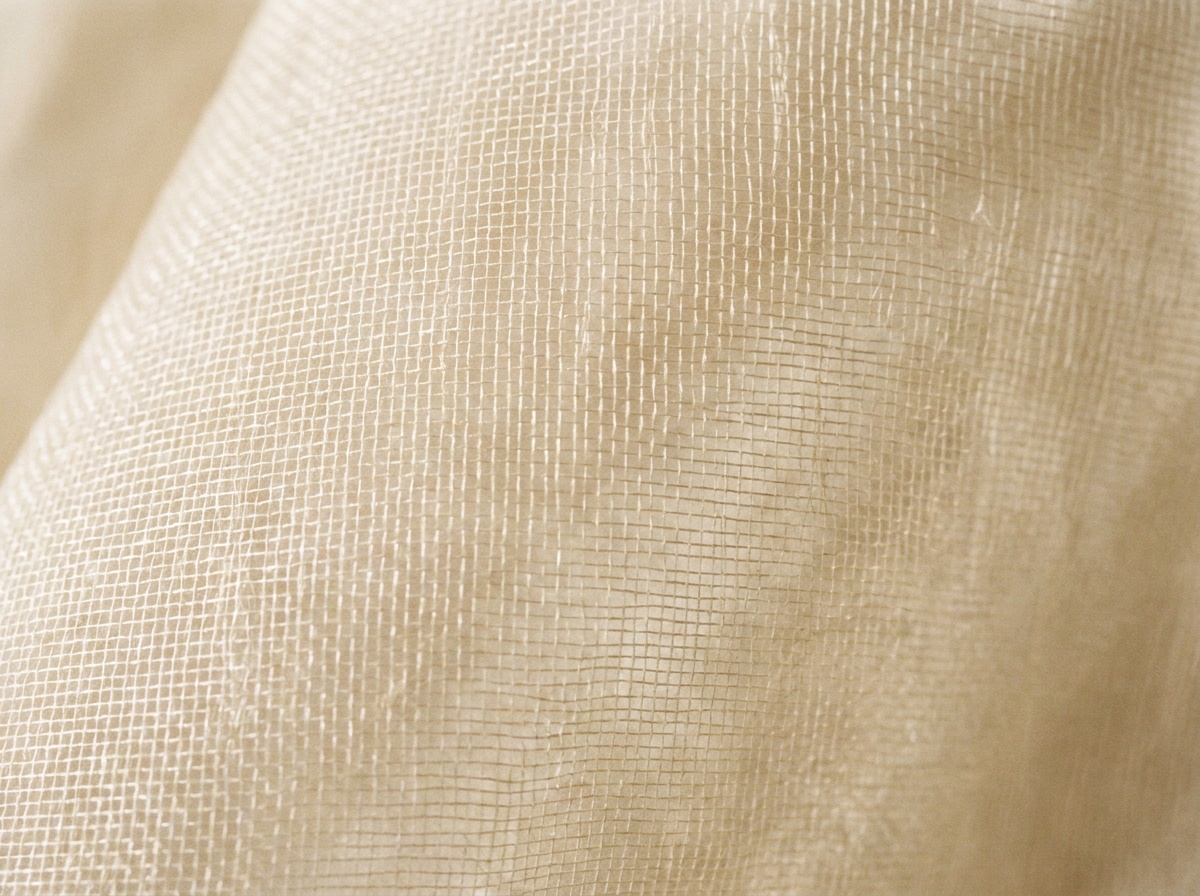
Silk Organza is a sheer plain weave built from tightly twisted, high-tension yarns that give it a crisp, wiry hand unlike any other silk. The twist is what sets it apart: it holds a shape rather than collapsing, so at roughly 30 to 50 g/m² (about 5 to 7 momme) it stays transparent and airy while behaving like a light structural mesh. The surface has a faint sparkle where light passes through the open weave, and the cloth stands away from itself instead of draping soft.
That stiffness makes organza as much a construction material as a fashion fabric. Sewers use it as an underlining to add body without weight, as a sew-in interfacing under collars and cuffs, and as a stable base for beading. As a face fabric it builds structured sleeves, overlays, and the crisp volume of bridal skirts. It presses to sharp, knife-clean folds and takes a hot iron well, holding a crease that softer silks refuse. It frays quickly along every cut edge, and the open weave shows seam allowances through the cloth, so enclose them.
For sewing, use a fine 60/8 or 70/10 sharp needle and fine thread, and hold tension light to avoid puckering the taut weave. French seams and narrow rolled hems are standard, since they trap the raw edges and stay near-invisible through the transparency. Pin only within seam allowances; the tight yarns keep holes. Cut on a single layer against a matte surface, because the slippery, springy cloth shifts and the sheen makes doubled layers hard to align. Applications run from full garments to interior structure inside a tailored piece.